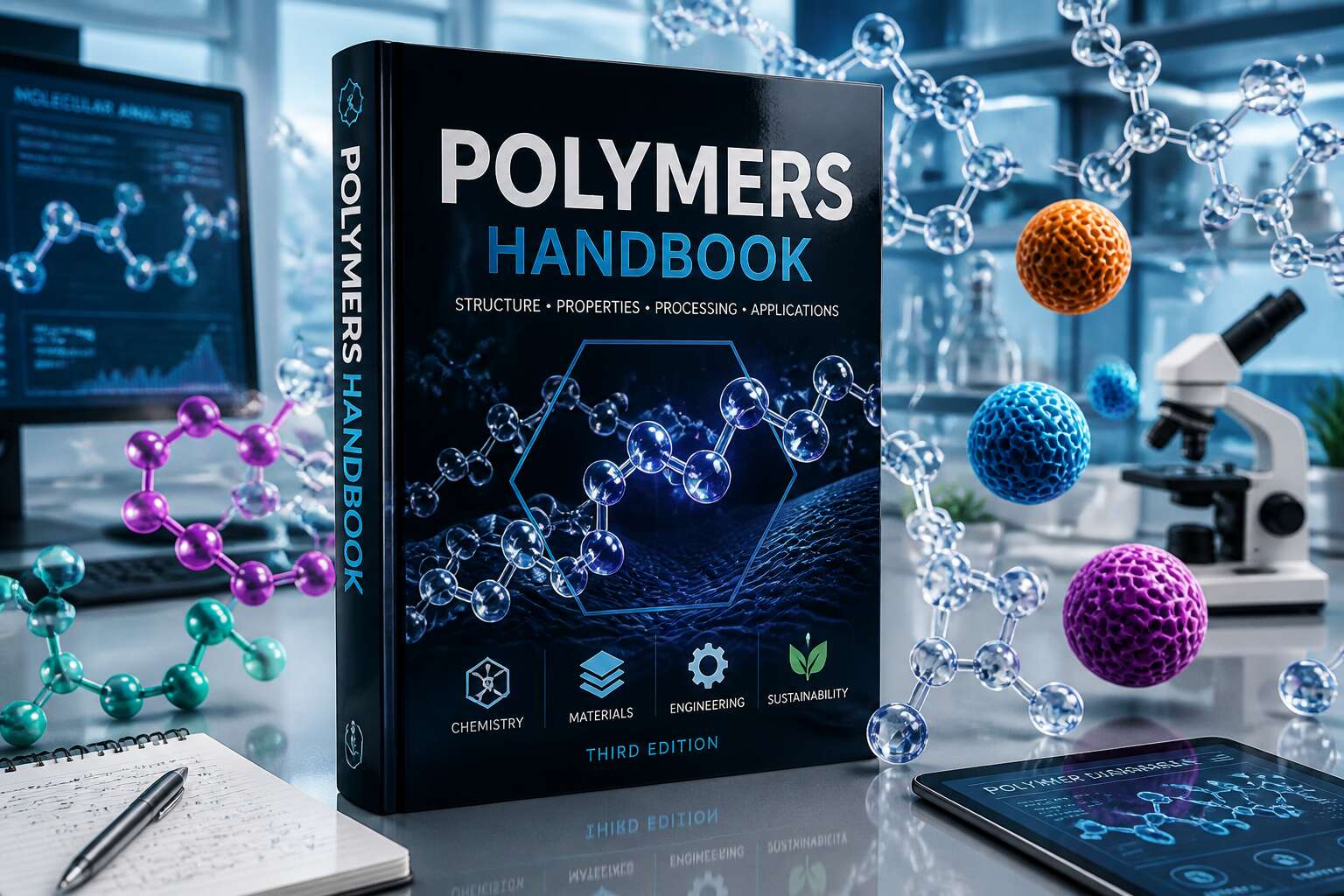
Understanding Polymer Science Basics
What Defines a Polymer: Structure and Classification
A single polyethylene molecule can contain over 200,000 repeating units. That statistic turns the everyday plastic bag into a lesson in molecular architecture. A polymer is defined by these long chains of monomers, where the arrangement dictates everything from flexibility to tensile strength.
Structure matters. Linear chains pack tightly, while branched chains create softer materials. Cross-linked networks, meanwhile, resist melting entirely. Classification follows these structural cues, sorting polymers into thermoplastics, thermosets, and elastomers. For engineers and students alike, a polymers handbook pdf offers the clearest map of these distinctions.
- Thermoplastics soften when heated
- Thermosets cure into permanent shapes
- Elastomers stretch and recover
Each category serves a different purpose, from piping to tyres. Understanding these basics prevents costly material missteps.
Thermoplastics vs. Thermosets: Core Differences
Roughly 380 million tonnes of polymers are produced annually, yet the divide between thermoplastics and thermosets comes down to molecular permanence. Thermoplastics rely on weak van der Waals forces between chains. Heat disrupts those bonds and the material softens reversibly. Thermosets form covalent cross-links during curing, so heat cannot separate them once set. A failed thermoplastic part can be reground and remoulded, while a failed thermoset part cannot.
Processing reveals the difference. Injection moulding requires high temperatures so thermoplastics can flow. Thermosets depend on a chemical reaction, often exothermic, to trigger cross-linking. Most professionals consult a polymers handbook pdf to compare glass transition temperatures and cure kinetics before choosing a material. That document becomes the deciding factor between a durable casing and a brittle disaster.
– Thermoplastics: reversible melting, weldable, recyclable.
– Thermosets: irreversible cure, high-temperature resistance, non-recyclable.
A polymer that flows under heat offers repairability. One that holds its shape forever demands precise manufacturing from the start. The right page in a polymers handbook pdf tells you which compromise suits your application. I have seen costly failures traced back to this single misunderstanding!
Copolymers and Blends: Tailoring Material Behavior
Copolymers and blends give you options that single homopolymers cannot. A copolymer connects different monomers in one chain, giving you alternating, block, or graft architectures. A blend physically mixes two polymers, often to balance stiffness and impact resistance. The catch is compatibility. Many blends are immiscible, so you get phase separation that ruins mechanical performance.
I have seen engineers consult a polymers handbook pdf to find specific answers, and you should too! Look for these entries:
- Miscibility maps at processing temperatures.
- Interfacial tension values for polymer pairs.
- Compatibilizer recommendations and loading levels.
That document spares South African processors from expensive surprises when working with variable recycled feedstocks.
Molecular Weight and Its Impact on Performance
Molecular weight determines how a polymer behaves more than any other single factor. It is the variable that separates brittle, low-performance grades from robust engineering polymers. In South African processing environments, where heat and shear vary wildly, understanding this relationship saves costly trial-and-error. A polymers handbook pdf will often include weight average and number average values, plus polydispersity indices that affect melt flow and toughness.
Consider what changes with molecular weight: shorter chains flow easier but sacrifice impact strength. Longer chains gain durability but become harder to process. The polymers handbook pdf tables give specific data on viscosity and mechanical response at different molecular weights. That is exactly what a designer needs when selecting a grade for rotational moulding or an extruded pipe. I have seen the difference on a factory floor. One polymer grade works perfectly; another, with a slightly different molecular weight, cracks within months. The handbook data explains why.
Key Properties and Characterization Techniques
Mechanical Properties: Strength, Toughness, and Elasticity
Strength, toughness and elasticity are not interchangeable, even though people often speak of them as if they are. A polymer can be strong yet brittle, or tough yet flexible. In practical terms, a plastic pipe in Johannesburg needs a different balance of these properties than a polymer bearing in Durban.
Mechanical characterization sorts this out. The most common methods are:
- Tensile testing for modulus, yield strength and elongation
- Impact testing to measure absorbed energy before fracture
- Dynamic mechanical analysis for viscoelastic behaviour across temperatures
Each method tells you something the others cannot. A polymers handbook pdf consolidates these test standards and property tables in one place, so engineers and technicians can compare data without flipping through multiple sources.
Thermal Transitions: Glass Transition and Melting Points
Every polymer carries two thermal landmarks that define its usable life. The glass transition temperature, Tg, marks the point where amorphous regions soften from rigid to rubbery. Crystalline domains hold their structure until the melting point, Tm, dissolves them into flow. Between these thresholds, a material behaves predictably.
These numbers govern real engineering decisions. A pipe installed in Johannesburg must withstand daytime heat without approaching its Tg. A marine bearing in Durban requires a melting point well above engine temperatures.
A polymers handbook pdf compiles thermal transition data for hundreds of grades. Engineers compare Tg and Tm values without consulting scattered journals.
Useful thermal markers include:
- Glass transition temperature for dimensional stability
- Melting point for processing limits
- Heat deflection temperature for load-bearing use
A thorough polymers handbook pdf connects these measurements to application limits, turning raw figures into reliable design criteria.
Rheology and Flow Behavior in Processing
Melt flow index only tells part of the story. A polymers handbook pdf lists the essential rheological data, from shear thinning to die swell. Processing faults often trace back to overlooked viscosity curves. Engineers who skip this data face warped parts and burnt batches.
Consider the die. Polymer melt exits under pressure, and its response to shear determines whether you get a clean profile or a misshapen shape. Key flow properties include:
- Shear viscosity, the resistance to flow.
- Die swell ratio, the expansion after the die.
- Melt strength, the resistance to stretching.
A polymers handbook pdf compiles these values across temperatures and rates. That means fewer trials, less scrap. In South Africa’s heat, outdoor piping demands melt flow that matches extrusion conditions. Without the flow data, you are guessing. With it, you control the process.
Spectroscopic and Chromatographic Analysis Methods
When a polymer fails in service, the cause often hides at the molecular level. Spectroscopy reveals what the naked eye cannot: residual monomers, oxidation byproducts, or unexpected branching. A polymers handbook pdf catalogs these spectral fingerprints, letting you match a suspect peak to a known degradation pathway.
Chromatography separates components by size or solubility. You might run gel permeation chromatography to verify whether your batch meets the molecular weight distribution on the data sheet. A polymers handbook pdf provides the reference curves and column conditions.
- Infrared spectroscopy for functional group identification
- NMR for chain microstructure
- GPC for molecular weight distribution
South African labs often rely on these methods when imported resins behave differently under local processing conditions.
Degradation and Environmental Stability Testing
In the harsh South African sun, polymer degradation is not a laboratory abstraction but a daily reality. Ultraviolet radiation, thermal cycling, and Highveld humidity place enormous stress on materials that appeared stable on paper. A polymers handbook pdf consolidates the data needed to predict long-term behavior, offering activation energies and oxidation induction times that remove the guesswork from service life estimation.
Environmental stability testing typically involves exposing coupons to accelerated conditions while tracking tensile retention and surface cracking. Common methods include:
- Weatherometer cycles that simulate years of sunlight in weeks
- Hydrolytic aging in controlled humidity chambers
- Oven aging to assess thermal oxidation susceptibility
Each approach leaves a distinct failure signature. A polymers handbook pdf links those signatures to specific polymer backbones, helping engineers determine whether a material will survive KwaZulu-Natal coastal salt or Mpumalanga thunderstorm moisture. We rely on these references daily when imported resins behave differently under local conditions.
Applications Across Industries
Automotive and Aerospace: Lightweight Components
The push for fuel efficiency and stricter emissions standards has forced manufacturers to rethink every gram of mass. Lightweight components are no longer a luxury, they are a necessity for meeting regulatory targets and improving operational range. This is where advanced polymer composites have moved from niche applications to the structural mainstream, replacing metal in brackets, housings, and even load-bearing panels. Engineers rely on a polymers handbook pdf to cross-reference the precise creep resistance and fatigue life of these materials before they ever reach a production line.
In the automotive sector, the shift is visible in electric vehicles. Battery enclosures and cooling system manifolds demand materials that can handle heat and vibration without adding excessive weight. Aerospace engineers face a different set of pressures, namely extreme temperature swings and intense UV radiation at altitude. A polymers handbook pdf provides the long term data sets needed to validate a material for a 20 year service life.
The selection process is highly specific. Professionals often look for the following properties when comparing polymer grades:
– Glass transition temperature in relation to operating environment
– Resistance to hydraulic fluids and aviation fuels
– Dimensional stability under continuous load
– Flammability ratings and smoke density values
These parameters dictate whether a part survives its first inspection or fails prematurely. The complexity of modern supply chains means that a component sourced in Gauteng might need to perform identically to one assembled in Munich. Without standardized reference data, that consistency is difficult to achieve. A polymers handbook pdf serves as the common technical language for design teams, quality auditors, and procurement specialists across the industry.
Medical Devices and Biocompatible Materials
Medical device development moves at a pace where a single failed compatibility test can set a project back months. Engineers screen materials for leachables, cytotoxicity, and hydrolytic stability before anything reaches animal trials. A polymers handbook pdf condenses those screening parameters into usable tables. Those tables save weeks during the first design review!
Biocompatibility is not a fixed property. It shifts with implant location, contact duration, and sterilization method. Ethylene oxide, gamma radiation, and steam each alter polymer surfaces differently. Design teams reference a polymers handbook pdf to anticipate those changes before prototyping.
- Bioresorbable sutures need predictable degradation rates.
- Catheter shafts require flexural fatigue resistance.
- Orthopaedic anchors demand creep resistance in saline environments.
South African manufacturers must satisfy global standards while addressing local regulatory oversight. Sterilization validation, packaging integrity, and shelf-life data all trace back to the same source. Reviewers in Pretoria expect the same evidence base as those in London.
Packaging and Sustainable Alternatives
Packaging is where polymer choices face the harshest public scrutiny. A single shift from virgin PET to recycled PET changes oxygen barrier properties, haze levels, and processing temperatures. A polymers handbook pdf provides those comparative datasets in one place.
The sustainable packaging movement creates new tension for South African converters. Compostable films sound ideal, but their degradation rates depend on local waste infrastructure. If municipal composting facilities don’t exist, a “compostable” label means nothing. Engineers consulting a polymers handbook pdf can verify which bio-based polymers actually meet industrial composting standards.
The data that matters most in packaging redesigns:
- Hydrolytic degradation profiles for PLA under humid coastal conditions
- Oxygen transmission rates for multilayer barrier films
- Migration limits for food contact applications
These numbers shift with film thickness, additive loading, and storage temperature. Static assumptions fail quickly in this sector.
How to Choose the Right Reference Material
Evaluating Data Accuracy and Source Credibility
Choosing the right reference material for polymer engineering starts with suspicion. I have seen property tables in a polymers handbook pdf that directly contradict the resin manufacturer’s own data sheet. Those discrepancies cost real money when you are specifying materials for a production run.
Start by checking the source. A polymers handbook pdf hosted by a university or professional institute carries more weight than one pulled from a file sharing site. Confirm the publisher, the edition year, and the authors’ affiliations. Reliable handbooks list test standards like ASTM or ISO methods beside each value.
– Check the publisher and edition date
– Compare the same property across two independent sources
– Look for named test standards, not vague test conditions
Remember that a single value in any handbook represents one grade, one batch, and one set of conditions. For South African suppliers, the local grade often differs from the generic data. Use the handbook as a screening tool, then confirm against the certificate of analysis.
Comparing Comprehensive Guides vs. Specialized Manuals
A comprehensive polymers handbook pdf spans thousands of pages, covering resin families from acrylics to polyurethanes. A specialised manual drills into one sector, such as medical tubing or rotational moulding. Both belong on a South African engineer’s desk, but they answer different questions. The comprehensive volume provides breadth, the specialised manual provides depth.
How you use the document determines the right choice. If you need a quick reference across multiple projects, a general polymers handbook pdf serves that purpose. If you work exclusively with one material class, the specialised manual contains the process parameters and grade variations you need.
Local conditions in South Africa often differ from published overseas values. The handbook gives you a starting point, the specialised manual refines it.
Digital Formats: Searchability and Portability
The first time you open a massive polymers handbook pdf on a slow connection, you feel the weight of it. The file might be hundreds of megabytes. That initial wait tests your patience before you even read a single page about melt flow index. In South Africa, where load shedding can interrupt your workflow, this matters more than you think.
Digital formats changed how engineers use reference materials. You can search for a specific grade of polyethylene in seconds. You can copy a table into your own notes. But the same file that gives you speed can also trap you in a maze of bookmarks and pop-up windows.
Here is what I have learned about the practical realities of using these documents:
– A 2,000 page file takes time to open on older laptops
– Mobile viewing forces you to zoom and pan constantly
– Printing specific chapters saves you from squinting at a screen
– Offline access requires foresight to download the file properly
The real challenge is knowing when a cloud drive helps you and when it fails you. A polymers handbook pdf stored online lets you access it from any site office. Yet the same file becomes useless when the network drops and you stand next to a machine that needs a quick answer. You need both the digital copy for search and a printed section for the floor. The wise approach is to understand your own working conditions before you commit to one format. A supervisor in Johannesburg might swear by his tablet. A technician in Sasolburg will want the hard copy in his toolbox. Each choice changes how effectively the material serves you.
Searchable text never replaces the value of a quick flip through pages you know well.
Updating Your Library with Latest Standards
Standards evolve, and a polymers handbook pdf from a few years ago may already lead you astray. Specifications change, test methods get revised, and customer requirements in South Africa often point to the latest editions. You cannot afford to certify a batch against an outdated table.
Building a current reference library takes discipline. Begin by auditing what you actually use on the floor and in the office. Check which standards the South African Bureau of Standards has updated recently. Then compare those revisions against the chapters in your existing handbook. You might find that a section on tensile testing has been rewritten entirely.
When you review your sources, work through a simple routine:
1. Confirm the edition and revision status of each standard.
2. Mark the date you last accessed your polymers handbook pdf.
3. Remove obsolete printed pages from your binder.
4. Set a reminder to recheck industry updates every quarter.
A current handbook gives you reliable data. An old one gives you false confidence. That is a dangerous trade in this industry.
Balancing Depth and Practical Usability
The right polymers handbook pdf does not exist in universal form. A lab manager in Johannesburg and a production engineer in Durban need different depths. One seeks thermal transition data, the other needs processing window specifics. Balance begins with knowing which questions you must answer daily.
I have seen engineers purchase comprehensive volumes only to abandon them for a quick reference sheet. Practical usability means the index leads you to the answer in under a minute.
- Check if the tables include typical injection moulding parameters.
- Confirm that every chapter has worked examples for your equipment.
Depth without accessibility is worse than no handbook at all. Accessibility without depth leaves you guessing on new specifications. A wise polymers handbook pdf sits at the intersection, offering both verified chemistry and shop floor guidance.
Cost Considerations and Open Access Options
Most engineers do not budget for reference material. A polymers handbook pdf can cost more than a laboratory viscometer, yet the viscometer breaks on a Friday afternoon while the handbook keeps answering questions at 2am. Think about which one your plant cannot survive without!
Open access exists for the frugal, and I have watched engineers make it work. University repositories hold older editions. Industry bodies publish application notes. Polymer manufacturers release abbreviated datasheets at no charge. None of these match a commercial reference for depth.
When cost dominates, ask three questions:
- Will you open the index more than ten times a month?
- Does the edition cover the polymer families you process?
- Can you save the file offline?
A free polymers handbook pdf skips the thermal transitions you rely on. A paid copy that stays closed is the same loss. The expense only makes sense when it matches your daily questions.
Tips for Navigating Technical Literature
Using Indexes and Appendices Efficiently
Flipping randomly through a polymers handbook pdf is a sure path to frustration. Instead, use the index as your starting point. It lists terms by exact page or section, so go there first when hunting for specific data like glass transition values or filler percentages. Appendices are equally valuable, as they cluster property tables, conversion factors, and sample spectra into one place. A quick scan of appendix headers often reveals what the main text buries.
For efficient navigation, follow this rhythm:
- Locate the broad chapter using the table of contents.
- Pin down the precise term through the index.
- Cross check any numbers with the appendix tables.
This sequence cuts search time dramatically. And remember, appendices usually list sources for traceability, so you can verify data without chasing references.
Cross-Referencing Property Tables and Graphs
Most engineers flip straight to a property table and assume the number is accurate. Mistake. A table gives a single value, but the graph reveals how that property behaves under strain, temperature, or time. In a polymers handbook pdf, these two views of the same data often live in separate chapters. Cross-referencing them separates a careless read from a reliable one.
Start with the table to lock down a specific value, like tensile modulus. Then find the corresponding stress-strain curve and confirm the slope at the relevant region. If the table says 3.2 GPa but the graph shows a nonlinear zone at low strain, that mismatch is a warning sign! Use this rhythm:
- Find the property in the table.
- Locate the graph by matching axis labels or sample code.
- Check the strain rate and test temperature in both places.
Graphs also expose what tables hide, such as yield points or cold drawing behavior. The polymers handbook pdf is dense, but this cross-check takes two minutes and prevents you from quoting a misread value.
Interpreting Data Sheets and Specification Charts
Data sheets carry an authority that is often undeserved. A specification chart in a polymers handbook pdf may list a single melt flow index, but that number emerged from a controlled laboratory. South African conditions, with intense UV exposure and fluctuating humidity, demand more scrutiny.
Watch for these common traps:
- Test standards differ across regions.
- Sample conditioning changes outcomes.
- Batch variation is rarely annotated.
The most reliable polymer engineers treat a data sheet as one input among several. They cross-check against the original standards before committing to a material. Projects that skip this step inherit hidden variation from the outset.
Staying Current with Peer-Reviewed Journals
Peer reviewed journals move faster than any polymers handbook pdf can capture. A handbook consolidates established knowledge, while journals carry the unresolved questions. For South African polymer engineers, this distinction matters. Local UV degradation studies, recycled material behaviour, and bio based feedstocks appear in journals years before they reach handbook editions.
I track three sources consistently:
- Polymer Degradation and Stability for weathering data relevant to our climate
- Journal of Applied Polymer Science for processing variables
- Macromolecules for fundamental property relationships
Each finding eventually reshapes the property tables you consult. The lag can stretch five years. Reading journals keeps you ahead of it, so the polymers handbook pdf becomes a baseline reference rather than the final word. That alone is worth the subscription!



0 Comments