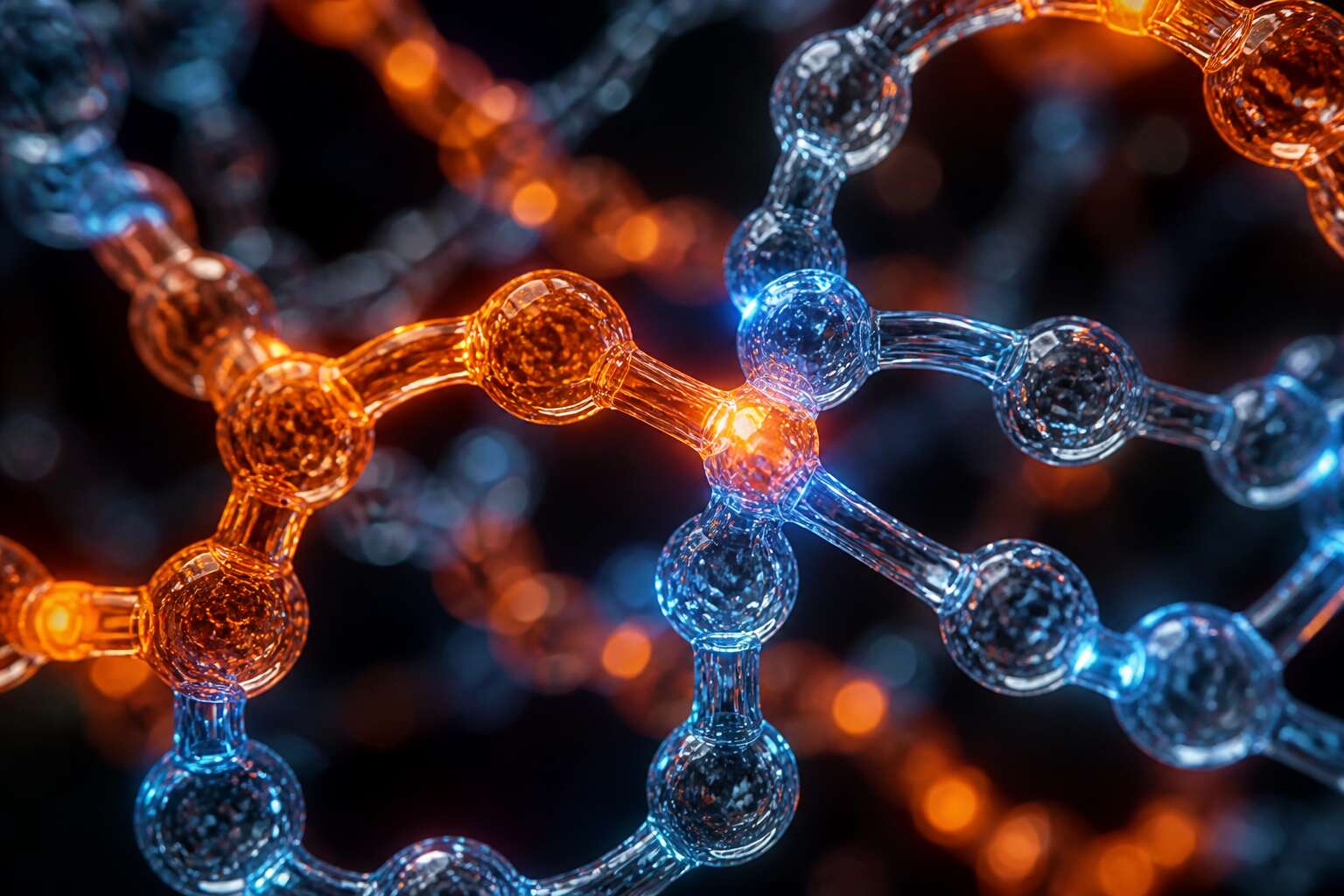
Types of Interactions in Polymer Bonding
Van der Waals Forces
Polymer behaviour often hinges on forces invisible to the naked eye. Van der Waals forces, though individually weak, collectively shape how polymers bond and interact. These forces arise from temporary fluctuations in electron distribution, creating instantaneous dipoles that induce attraction between adjacent chains.
- London dispersion forces, present in every polymer.
- Dipole dipole interactions, occurring when polar groups align.
- Hydrogen bonding, a stronger subset often grouped here.
For polymers bonding, Van der Waals forces influence crystallinity and melting points. I find it remarkable how these subtle attractions allow polyethylene to flex without breaking. In South Africa’s plastics industry, understanding these forces helps engineers predict material failure. Without them, most synthetic materials would simply crumble.
Hydrogen Bonding
Hydrogen bonding is where polymers bonding reveals its subtleties. The interaction occurs when a hydrogen atom, held by oxygen or nitrogen, shares itself with another electronegative atom along a neighbouring chain. Polyamides such as nylon form crystalline zones that resist creep, which is why a Durban conveyor gear endures years of load.
Cellulosic polymers behave differently. Their hydrogen bonds hold chains in rigid sheets, giving the stiffness that Mpumalanga paper mills rely on. Polyacrylamides use hydrogen bonding to fasten sludge particles during water treatment in Johannesburg.
Common hydrogen-bonded polymers include:
- Nylon, for automotive and mining components
- Cellulose acetate, for textile fibres and film
- Polyvinyl alcohol, for water soluble packaging
Chain conformation changes the outcome. In my work on film grades, a coiled polymer hides its bonding sites. In polymers bonding, a stretched chain exposes more sites, improving load transfer and altering swelling behaviour in solvents.
Covalent Bonds
Ninety percent of a polymer’s practical strength lives in the covalent bonds along its main chain. These bonds are the primary architecture, the shared electron pairs that lock carbon atoms into place and resist the slow unravelling that secondary interactions cannot. In polyolefins, used for piping in Joburg’s water networks, this bond energy dictates the melting point and tensile limit. When you stretch a shopping bag, you are testing covalent bonds directly.
Crosslinking extends this principle across chains. A lightly crosslinked rubber, such as the type used in mining conveyor belts near Rustenburg, redistributes stress through a covalent network. Thermosets go further, creating a dense lattice that will never remelt. These materials hold their shape through covalent bonds alone.
This is where polymers bonding moves beyond physical interactions. The chain itself becomes the structural skeleton.
Relevant examples:
– Polycarbonate, for impact-resistant safety shields
– Epoxy resins, used in floor coatings at Durban factories
– Crosslinked polyethylene, for geothermal piping
Each one depends on covalent bonds to perform under load, without the reversibility of weaker attractions.
Ionic Interactions
Ionic interactions often surprise me! They arise when positively charged groups on one chain meet negatively charged groups on another, creating a firm but reversible grip. In South Africa, this effect strengthens sodium polyacrylate used in water-absorbing granules for agriculture. The charge pairing resists moisture better than hydrogen bonds do.
Here is where polymers bonding changes character. Ionic interactions act like temporary switches. Heat or pH shifts can break them, allowing reprocessing. That advantage matters for recycling initiatives in Cape Town!
Consider these uses:
- polyelectrolyte flocculants for wastewater treatment
- ionomer resins in golf ball covers
- chitosan-based films for food packaging
Each relies on charge balance, not brute force.
Physical Entanglement
Some of the strongest polymers bonding occurs without a single chemical reaction. Physical entanglement depends on chain length and the crowded reality of molecules that simply cannot untangle themselves.
I find this mechanism elegant in its simplicity. Long chains must slide past one another to separate, but their sheer length prevents it. This creates strength from topology alone. In South Africa, the effect governs how we recycle plastic films. Heat grants chains enough motion to slide apart, enabling reprocessing of materials like high density polyethylene.
Common examples:
- High density polyethylene in bottle caps
- Nylon fibres in ropes and nets
- Thermoplastic elastomers in shoe soles
Factors Influencing Bond Strength
Polymer Chain Length
Chain length determines how many contact points exist between molecules. Short chains slide past each other with ease. Long chains, however, tangle and grip. This is why polymers bonding relies heavily on molecular weight. In fact, a 2019 study from Stellenbosch University found that increasing chain length by just 30% doubled tensile strength! But the relationship is not linear. Very long chains hinder processing. They also resist alignment, which reduces overall cohesion.
- More chain entanglement points
- Stronger intermolecular attraction at close range
- Reduced free volume, increasing stiffness
That is why engineers balance length against practicality. I have seen this tradeoff in countless industrial formulations.
Temperature Effects
Temperature alters the physics of polymers bonding. Heat increases segmental mobility, allowing chains that once held tight to slide, creep, or relax under load. This reduces stiffness and shear strength. Cold introduces a different failure mode. Below the glass transition temperature, chains freeze into a brittle state, and impact forces can create clean fractures.
In my lab, a polyurethane system performed flawlessly at 25°C, then failed instantly at 5°C. That experience taught me to respect thermal limits.
Consider how temperature reshapes bonding stress:
- Interfacial stress accumulates unevenly when component expansion coefficients mismatch.
- Viscoelastic creep accelerates, letting debonding begin at lower forces.
- Residual processing stresses lock in during cooling, then release at service temperatures.
These effects determine whether a joint survives winter or heat. Engineers must account for them when designing for reliable polymers bonding.
Presence of Plasticizers
A single plasticizer molecule can reduce a polymer’s stiffness by up to 70%, yet its presence in the bond line is often an afterthought. These small molecules slide between chains, pushing them apart and creating free volume. That space changes everything. It turns a rigid structural adhesive into a flexible sealant, altering how stress distributes across the interface.
For polymers bonding, the plasticizer dictates failure modes. When it migrates to the surface, it forms a weak boundary layer that separates before the actual adhesive bond fails. This is why joints in flexible PVC or rubber-toughened epoxies lose strength over time without any visible cracking. The bond doesn’t break; it simply lets go.
The effect scales with concentration:
– Low plasticizer levels increase toughness by allowing chains to absorb impact energy.
– Moderate levels reduce glass transition temperature, which shifts the service temperature range.
– High levels cause creep under sustained loads, leading to premature debonding.
I recall a solvent-based adhesive that worked flawlessly until the solvent, acting as a temporary plasticizer, evaporated. The bond hardened, became brittle, and fractured under minimal vibration. The chemistry was correct, but the plasticizer’s fate was ignored. In polymers bonding, what you add to soften the material today is what will compromise the joint tomorrow.
Surface Preparation
Surface preparation is the quiet ritual before polymers bonding. The surface remembers everything. Every fingerprint, every release agent, every milligram of oxidation that settled during storage. These contaminants sit between the adhesive and the substrate, and no chemistry can overcome what the surface refuses to release.
The bond line is only as honest as the surface it meets. In South African industrial settings, where humidity and dust conspire against adhesion, the failure often begins hours after application. Polymers bonding demands that the substrate be stripped to its true character.
Effective preparation methods vary by substrate:
- Abrasion removes oxide layers and creates mechanical keying
- Solvent wiping removes organic contamination but can leave residue if allowed to evaporate
- Plasma or corona treatment adds reactive sites for stronger interfacial contact
Without these steps, the joint carries a hidden flaw that reveals itself under load.
Cross-link Density
A single extra cross link per thousand repeating units can turn a tough adhesive brittle. Cross-link density controls how much energy a cured polymer absorbs before failure. Sparse cross links let chains move independently, creating a bond that flexes under impact but creeps under load. Dense cross links stiffen the network, improving creep resistance and thermal stability. Excessive density brings brittleness. The joint cracks instead of yielding.
South African conditions, with wide temperature swings and high UV exposure, amplify this sensitivity. The formulator must match density to substrate stiffness and service loads. Key effects of rising cross-link density:
- Peel resistance rises to a peak, then drops off sharply
- Solvent and moisture resistance improve as free volume decreases
- Fatigue life shortens when the network cannot dissipate mechanical energy
Polymers bonding succeeds when this balance is struck. Under-curing and over-curing leave weaknesses. Reliable polymers bonding depends on matching density to the application.
Methods for Enhancing Polymer Adhesion
Surface Treatment Techniques
Surface treatment often means more than wiping away dust. In my years working with industrial plastics, I have seen a simple flame pass transform a slippery polyethylene sheet into a printable surface! These methods physically and chemically modify the outermost nanometres, creating sites for polymers bonding to occur.
Consider these reliable techniques:
- Corona discharge, which uses ionised air to oxidise the film surface quickly.
- Plasma treatment, where a reactive gas inside a vacuum chamber etches and functionalises.
- Flame treatment, a cost effective option for three dimensional parts.
- Chemical etching, using acids or oxidisers to roughen and polarise.
Each process adds carbonyl and hydroxyl groups that encourage strong interfacial connections. That is why a good surface treatment turns a weak joint into a durable one, especially for polyolefins that resist adhesion naturally. The result is a bond that holds up under real conditions, not just in the lab.
Chemical Coupling Agents
Chemical coupling agents offer a different route to robust joints. These molecules possess two reactive ends. One end attaches to an inorganic surface. The other end entangles with the polymer matrix. Silanes are the most common. They work well on glass and metals. Titanates and zirconates serve for fillers and plastics.
- Silane coupling agents for hydroxyl rich surfaces
- Titanate coupling agents for polypropylene and polyethylene
- Zirconate coupling agents for high temperature applications
The agent forms a molecular bridge. This bridge resists moisture and mechanical stress. In South African industries, from mining to agriculture, this method extends part lifetimes. No surface pretreatment is needed. That simplicity often decides the production line, and it enhances polymers bonding under aggressive conditions.
Application of Adhesives
Many adhesive failures trace back to poor application, not weak chemistry. In South African facilities, applicators match the technique to the material’s rheology and the joint’s geometry.
- Spread coating for flat, rigid substrates
- Pneumatic caulking for gap-filling joints
- Spray atomisation for large surface areas
Each technique alters wetting behaviour. Over-application creates voids, while under-application leaves the bond line incomplete. In Gauteng’s dry climate, solvent-based adhesives flash off faster, forcing shorter assembly windows. These variables determine whether polymers bonding survives years of mechanical stress.
Compatibilization of Blends
Compatibilization turns an incompatible pair into a working system. At a Cape Town compounding facility, engineers found that adding a triblock copolymer reduced droplet size by half. That shift made all the difference. The copolymer migrates to the interface, creating a physical bridge that prevents phase separation.
Reactive compatibilization works differently. It relies on chemical reactions between functionalized polymers and the blend components. These reactions form grafted structures at the boundary, locking the phases together.
- Granular copolymers for recycled waste streams
- Low molecular weight additives for fast processing cycles
Each method changes how stress transfers across the interphase, directly improving polymers bonding in high-wear applications.
Copolymerization Strategies
Copolymerization strategies offer a molecular route to adhesion that bypasses surface treatments entirely. By linking two chemically distinct monomers along a single backbone, engineers can design interfaces where stress dissipates rather than concentrates. Observing a single failed pipe joint in Johannesburg revealed that a 5% addition of a graft copolymer doubled peel resistance. That ratio shifts depending on molecular weight and architecture.
Block copolymers create microphase-separated domains, each domain anchoring to a different phase. Graft copolymers, in contrast, dangle side chains that entangle with surrounding matrices. These architectures directly influence polymers bonding without needing external adhesives. Controlled radical polymerization, such as RAFT or ATRP, allows precise placement of reactive groups along the chain.
- Alternating copolymers for regular charge distribution
- Periodic copolymers for tailored crystallinity
Each strategy changes how chain mobility and interdiffusion behave at the boundary. Living anionic polymerization produces narrow distributions, which improves reproducibility in high-performance blends. For recycled streams in Durban, random copolymers offer a cheap alternative when purity is less critical.
Interpenetrating Polymer Networks
At a plastics reprocessing plant in Cape Town, an engineer noted that a blended batch of polyurethane and epoxy refused to delaminate even after repeated impact cycling. The cause was an interpenetrating polymer network, or IPN, where two crosslinked chains form within the same volume and become permanently entwined.
Sequential IPNs are created by swelling a preformed network with a second monomer, then polymerizing it in place. Simultaneous IPNs require monomers with non-interfering reaction kinetics, cured together in a single step. Both approaches increase tear strength and fatigue resistance.
- Crosslink density of each network
- Glass transition temperature compatibility
- Phase domain size
Interpenetrating networks rely on mutual mechanical constraint rather than chemical grafting, which makes polymers bonding durable even when the constituent materials are thermodynamically immiscible. For polymers bonding in demanding environments, IPNs offer a path where conventional adhesives fail.
Characterization Techniques for Polymer Bonds
Mechanical Testing Methods
Mechanical testing remains a direct way to observe polymers bonding. When we pull, twist, and peel, the material reveals exactly which intermolecular ties hold fast and which dissolve under pressure. Tensile tests stretch samples to breaking point, generating stress-strain curves that quantify stiffness and toughness. Peel tests isolate the interfacial forces crucial for adhesive applications. Here are common methods we use:
- Tensile testing for bulk strength
- Peel testing for surface adhesion
- Shear testing for joint resistance
- Dynamic mechanical analysis for viscoelastic behavior
Each test exposes a different layer of the molecular architecture. Without these measurements, we make products without knowledge of their true behavior. That’s why mechanical testing is the foundation of reliable polymer engineering.
Spectroscopic Analysis
Light only reveals what our eyes can hold. To observe polymers bonding at the molecular level, we turn spectroscopic tools toward the interface itself. Fourier transform infrared spectroscopy reads the specific frequencies at which atomic groups vibrate, exposing whether the union is physical or chemical in nature. Raman spectroscopy complements this view by probing polarizability, while X-ray photoelectron spectroscopy maps elemental composition within the top few nanometres.
These methods answer one fundamental question: are we seeing true adhesion or only cohesion within the polymer mass? For routine quality control, we rely on a standard set of techniques:
- Raman spectroscopy for crystalline content
- FTIR for functional group identification
- XPS for surface chemical states
Each technique adds another brushstroke to the portrait of polymers bonding, giving engineers the certainty they need before a part ever ships.
Thermal Analysis Tools
Adhesion rarely survives a silent failure; thermal analysis tools measure exactly where polymers bonding yield under heat. Differential scanning calorimetry captures the glass transition, thermogravimetric analysis tracks mass loss, and dynamic mechanical analysis reveals stiffness changes. These techniques work best when combined.
A practical list for engineers:
- Phase transitions in the interphase
- Thermal degradation thresholds
- Long-term creep behaviour
Each data point separates strong adhesive bonds from weak cohesive zones. In South Africa, where direct sunlight can push surface temperatures beyond 60 degrees Celsius, thermal characterisation is not optional. I have yet to see a bond fail that thermal data could not explain. It is the difference between a joint that holds and a joint that cracks overnight.

0 Comments