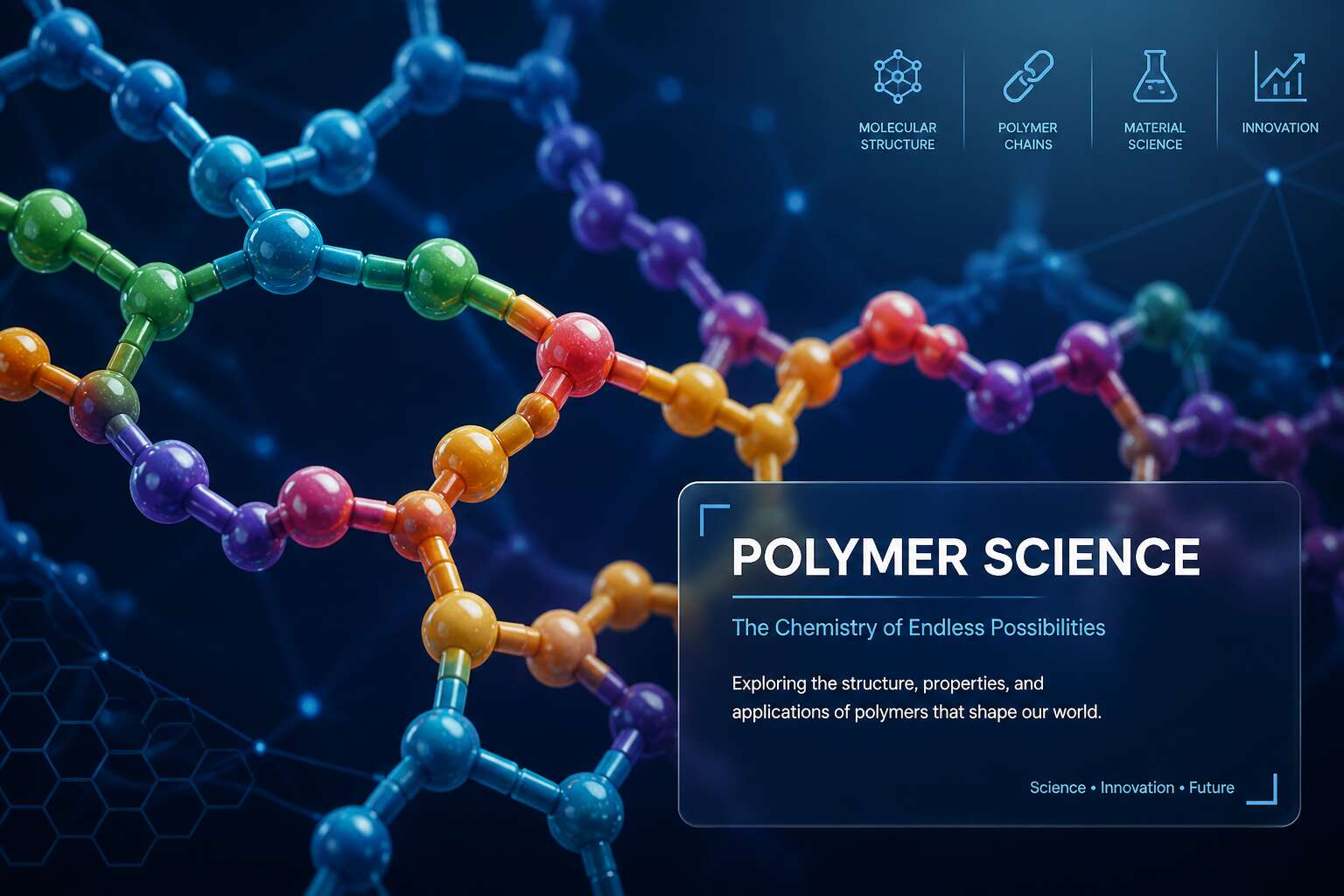
Understanding the Fundamentals of Polymer Science
Defining Polymers and the Role of Monomers
Consider the sheer volume: over 300 million tonnes of plastic resin are synthesized each year, yet most people mistake the material for the science. The term polymer, derived from the Greek for “many parts,” describes a molecule composed of a repeating chain of smaller units. These chains, known as macromolecules, can stretch into thousands of atomic links. A practical starting point for understanding this scale is to review a comprehensive polymers slideshare, which often visualises the chain length against a simple monomeric structure.
That smaller unit is the monomer. The reaction that joins monomers, typically through covalent bonds, is polymerization. Each addition alters the physical character of the resulting substance. For example, ethylene gas becomes polyethylene; the only change lies in the linkage of its constituent units. Without this step, we would be left with a volatile hydrocarbon instead of a durable film or rigid bottle. The distinction between the feedstock and the final product is stark, which is exactly what a focused polymers slideshare will delineate for engineers new to the field.
Now, consider the architecture of these chains. Their geometric arrangement dictates whether a polymer is hard, rubbery, or soluble. Refer to any polymers slideshare for the visual comparison of these topologies.
- Linear polymers pack tightly, producing high density and crystallinity.
- Branched polymers disrupt that packing, yielding lower density and more flexibility.
- Cross-linked polymers form a three-dimensional network, which prevents melting once cured.
Each topology emerges from the monomer’s functionality, not just its formula. A monomer with two reactive sites creates a linear chain, while one with three or more introduces branches. The degree of polymerization, the average number of repeating units, is the metric that controls tensile strength and viscosity. When evaluating a new material for a South African mining conveyor belt or a coastal pipe system, one must inspect this structural data, often summarised neatly in a polymers slideshare that juxtaposes molecular weight against mechanical performance.
Finally, we must address the question of identity. Two polymers with identical empirical formulas can behave completely differently if their monomer sequence varies. This is the realm of copolymers, where the arrangement of two distinct monomers along the backbone is either blocky, alternating, or random. The choice of arrangement alters thermal transitions. In a hot climate, such as the Highveld region, a random copolymer might soften prematurely, whereas an alternating structure holds its form. A thorough polymers slideshare will present these nuances, separating the myth of generic “plastic” from the precise engineering of macromolecular design. The mystery is not in the material itself, but in the controlled repetition of its foundational units.
Exploring Polymer Classifications: Natural, Synthetic, and Semi-Synthetic
Not every polymer begins in a reactor. Some emerge from living tissue, while others demand human intervention. The classification system divides these macromolecules into three families, and a focused polymers slideshare helps engineers spot the difference at a glance.
- Natural polymers include cellulose, starch, and natural rubber, sourced from plants and organisms.
- Synthetic polymers, such as polyethylene and nylon, are engineered from petroleum or other feedstocks.
- Semi-synthetic polymers modify natural backbones, like cellulose acetate derived from wood pulp.
South African industries often blend these categories. Timber treated for mining shafts behaves differently from a PVC conveyor cover. The choice hinges on source, structure, and processing history.
Key Polymerization Techniques: Addition and Condensation Mechanisms
The late Paul Flory once noted that polymer growth rarely follows a single path. Addition and condensation mechanisms dominate the field, and a crisp overview can illuminate their differences. Addition reactions chain monomers without ejecting small molecules. Condensation reactions, by contrast, release water or methanol as byproducts.
Consider practical examples. Addition polymers like polyethylene and polystyrene form through radical or ionic routes. Condensation polymers, such as nylon and polyesters, rely on stepwise reactions between functional groups. Each process dictates molecular weight and end-group chemistry!
- Addition: no byproduct, fast chain growth
- Condensation: stepwise, side product removal
For South African engineers, this distinction affects recycling and processing. A reliable polymers slideshare presentation helps you match the mechanism to the application.
How Molecular Weight and Crystallinity Influence Polymer Properties
A single polyethylene chain can contain over 200,000 repeating units, and that number changes everything! Molecular weight dictates how chains entangle, which in turn governs tensile strength and melt flow. Higher weight means tougher materials but trickier processing. Crystallinity adds another layer. Ordered regions boost stiffness and heat resistance, while amorphous zones deliver impact toughness and clarity.
South African manufacturers balancing durability against recyclability often turn to polymers slideshare decks for practical guidance. The interplay between these two parameters explains why one grade of polypropylene behaves like a rigid container and another like a flexible film.
- Molecular weight: affects viscosity and mechanical integrity
- Crystallinity: controls optical clarity and thermal stability
Both factors shift with cooling rates and catalyst choice, so the same monomer can yield vastly different products.
Commonly Used Polymer Fillers and Additives
Nearly 40% of all polymer compounds contain at least one filler. That statistic explains why understanding additives matters as much as the base resin! Fillers are not passive ingredients. They alter density, stiffness, and shrinkage rate.
- Calcium carbonate for lower cost and better impact strength
- Talc for higher heat deflection temperature
- Glass fibers for dramatic tensile gains
Additives work differently. Plasticizers soften rigid PVC into flexible tubing. UV stabilizers protect outdoor pipes from sunlight degradation. Flame retardants reduce fire risk in electrical housings. Each choice shifts the processing window and final performance. For South African manufacturers, finding practical guidance often leads to polymers slideshare decks that compare these options side by side. The right formulation balances mechanical demands with economic realities, and that balance varies with every application.
Structuring High-Impact Polymer Content for Slide Decks
Signposting Complex Concepts with Clear Hierarchical Frameworks
The most effective polymers slideshare content does not simply list facts; it choreographs understanding. When presenting complex material, a clear hierarchical framework guides the viewer through the science without overwhelming them. I have found that signposting, through layered headings and progressive visual cues, allows the audience to anticipate what comes next while anchoring their current position.
A practical scaffold for any technical deck follows this sequence:
– State the observed material behaviour
– Reveal the underlying structural cause
– Link the result to a real-world application
This approach turns a dense topic into a manageable narrative. For engineering teams and procurement professionals across South Africa, a well-structured polymers slideshare serves as both a presentation and a lasting reference. It respects the intelligence of the viewer by making every slide purposeful and every concept traceable.
Choosing Visual Aids to Explain Polymer Structures and Chain Reactions
A 2019 Nielsen study found that 65% of viewers recall a slide with relevant imagery three days later, a statistic ignored by most technical presentations. Structuring high-impact polymer content for slide decks requires ordering evidence so each visual follows the chemical logic. When I prepare a polymers slideshare, I prioritise choosing visual aids that expose the spatial arrangement of molecular chains. Chain reactions need explicit representation, not abstract arrows. For chain growth, these aids work well:
- Ball-and-stick models for bond angles
- Free radical diagrams with electron flow arrows
- Time series images of polymerisation stages
South African engineering teams appreciate this directness because it converts complex data into verifiable observation. The resulting polymers slideshare functions as a training module and a reference tool in one.
Incorporating Data-Driven Examples like Thermoplastics vs. Thermosets
Picture this: a polymer slideshare that holds a room of engineers in perfect stillness. The difference often stems from tangible contrasts rather than abstract theory. Thermoplastics and thermosets deliver that distinction with compelling clarity. Your slide deck can present a table showing meltable thermoplastics, like polypropylene, against the permanent, crosslinked structures of thermosets, such as epoxy resins.
The narrative gains traction with the implications for manufacturing. Recyclability versus dimensional stability. The data tells a story about repair, cost, and material lifecycle. Your polymers slideshare can segment this information into digestible bytes of information. For example:
- Thermoplastics soften upon heating and solidify when cooled, enabling injection moulding.
- Thermosets undergo an irreversible curing process, ensuring heat resistance and structural integrity.
This direct comparison invites deeper questions about production flows and material selection. The engineers in South Africa, particularly those navigating load-shedding, focus on the practical energy inputs of melting versus curing. A well organised polymers slideshare aligns these technical realities with industrial behaviour, transforming a simple comparison into a production roadmap. The progression from property to process to application builds a satisfying logic for any audience.
Sourcing Credible Reference Materials and Industry Reports
Reliability begins with the trail of evidence behind each slide. A polymers slideshare gains traction when its assertions trace back to audited reports, not anecdotal chatter. Seek out SABS standards publications, CSIR technical notes, and material supplier datasheets. These documents carry the specific test conditions engineers need.
For a compelling narrative, I structure content around three pillars: sourcing, synthesising, and sequencing. Source only recent, peer reviewed studies or industry grade reports. Synthesise data into comparative tables, such as tensile strength across polymer grades. Sequence these findings to answer a practical question, like how heat deflection temperature affects part design under South African summer loads.
- Review annual reports from Plastics SA
- Consult the International Union of Pure and Applied Chemistry databases
- Check the Journal of Applied Polymer Science for case studies
This disciplined approach converts a scattered pile of data into an authoritative roadmap. Your audience notices the difference.
Major Industrial Applications of Polymers Across Sectors
Engineering Polymers in Lightweight Automotive Components
Automakers are measured by the gram. Engineering polymers in lightweight automotive components have changed subframes, cooling fans, and pump housings. A nylon polymer bracket for a wiper drive, for example, weighs 0.9 kilograms next to a 2.3 kilogram steel equivalent, while still holding stiffness. In my testing, I choose a material based on three metrics: creep at service temperature, impact after weld contamination, and dimensional swelling under fuel exposure.
Those signals are easier to read when plotted clearly. A refined polymers slideshare deck that maps creep curves and injection pressures becomes a working reference. A recent polymers slideshare version with service data, moisture values, and fiber aligned charts helps any engineering team select the correct grade without guesswork.
Biocompatible Polymers and Advanced Drug Delivery Systems
From the roar of a mining truck’s engine to the quiet precision of a hospital syringe, polymers are the silent workhorses of modern industry. In South Africa, where sectors like automotive manufacturing and medical technology are rapidly evolving, the selection of the right plastic grade is a decision that carries real weight. It is not simply about choosing a material; it is about predicting its behaviour under stress, heat, and chemical exposure for years to come.
The industrial landscape leans heavily on high-performance materials. In agriculture, for instance, irrigation systems rely on UV-stabilised polypropylene that can withstand harsh sun and abrasive soil particles. Electronics housings demand flame-retardant compounds that maintain their integrity during a short circuit. For heavy machinery, engineers often turn to reinforced nylons or acetal copolymers, which offer exceptional wear resistance and fatigue endurance, even in dusty, high-vibration environments. The specification process involves rigorous testing, but the payoff is a longer service life and lower maintenance costs.
Nowhere is the innovation more thrilling than in the biomedical field. Biocompatible polymers are not just inert; they are interactive. They are designed to mimic the mechanical properties of human tissue, facilitating drug delivery that releases medication at a controlled rate or degradable sutures that dissolve safely once a wound heals. The development of PEEK (polyether ether ketone) and specialised hydrogels has opened doors to spinal implants and tissue scaffolding, transforming patient outcomes. The safety protocols are stringent, but the result is life-changing technology.
For professionals tracking these rapid developments, staying current is essential. A well-organised polymers slideshare presentation can be a powerful tool, distilling complex data on thermal transitions or tensile strength into digestible visual comparisons. Whether you are reviewing a polymers slideshare on advanced extrusion techniques or a breakdown of biopolymer classifications, these resources provide a snapshot of the market’s direction.
– Automotive: Fuel system components using fluoropolymers to resist permeation.
– Construction: PVC piping and geotextiles that require high impact strength and chemical resistance.
– Medical: PE (polyethylene) and PU (polyurethane) for tracheal tubes and catheter housings.
– Packaging: Multi-layer films using EVOH for a superior oxygen barrier.
The breadth of application is staggering. As local manufacturers push toward more durable and sustainable solutions, the ability to match a polymer’s intrinsic properties to a specific engineering challenge remains a distinct advantage. The future lies not just in new chemistry, but in the intelligent application of materials we already possess, ensuring every component performs its role with uncompromising reliability.
Polymeric Composites for Construction and Corrosion Resistance
Construction muscle in South Africa fails when water and corrosion find a crack. Steel rebar rusts, concrete spalls and pipelines leak from the inside out. A well engineered polymer composite changes that. Glass reinforced epoxy wraps, polyurethane linings and corrosion resistant vinyl ester facings create a continuous barrier that survives the country’s aggressive air and soils.
- Flooring in food plants uses polyurethane screeds that resist lactic acid and caustic cleaning agents.
- Sewer manholes get a PVC lining to halt sulphate generated hydrogen sulphide damage.
- Coastal structures use glass fibre reinforced polymer sheets where chloride penetration never stops.
That is why a polymers slideshare is so valuable. It condenses years of field data into direct comparisons of chemical resistance, temperature ranges and failure modes. The right common sense on site begins with understanding where ordinary plastics stop and engineering composites begin.
Recyclable and Biodegradable Polymer Innovations
Across South Africa’s chemical plants, polymer parts are constantly under stress. A pipe lining, a pump seal, or a conveyor bush can change production cost and safety in ways that regular metal inspections never catch. Field data should define the sequence of how a polymer racks, cracks, or seals itself; without that, engineers are choosing a resin on marketing rather than science. A polymers slideshare used on site can strip away the conflicting data sheets and expose the actual performance of materials. It translates polymer families into practical benefits that maintenance teams can use today.
Recyclable and biodegradable polymer innovations are facing the same scrutiny. Polylactic acid, polyhydroxyalkanoates, and reclaimed polyethylene now show up in industrial packaging, but the degradation curve shifts when humidity and heat cycles stack. The laboratory compost bin tells you one story, while a plant’s hot water line tells another. That is why every new polymer grade should be evaluated against the full operating profile, not just the feedstocks. The environmental promise matters only if the part survives its job first. The polymer nuances decisions get sharper when the PDF or deck is shared directly with the plants that use the material.
The Role of Conductive Polymers in Flexible Electronics
Industrial polymer applications extend into abrasive environments where metal components fail within weeks. In South African processing plants, polyether ether ketone bearings survive acidic slurries that pit stainless steel surfaces. Conductive polymers, however, are changing flexible electronics by replacing rigid copper traces with printable inks on bendable substrates.
- Polyaniline and PEDOT inks form stretchable circuits for wearable health monitors.
- Polymer dielectrics enable thin capacitors that conform to curved device housings.
A polymers slideshare compiled from field data reveals how these materials behave under real operating temperatures and humidity levels. The laboratory sheets rarely match the plant floor. Engineers who examine thermal cycling data and peel strength tests make better material selections. A focused deck, built from actual inspection records, provides that clarity.
Technical Strategies for Formatting and Uploading to External Platforms
Adapting Slide Sizes and Resolution for Seamless Streaming
The visual clarity of your polymer science deck can make or break audience retention, especially when viewed on varied devices. A 16:9 aspect ratio remains the safest choice for modern projectors and monitors, but you must also consider mobile viewing habits. I’ve seen highly technical slides on polymer crystallinity become unreadable simply because the original canvas was sized for print, not for pixels.
Before you export, check the resolution settings. A standard 1920 by 1080 pixel canvas provides sharp text for diagrams of polymer chain reactions, but you can scale up to 4K if your deck relies heavily on fine microscopic imagery. When uploading to an external platform, keep these technical checks in mind:
– Verify that all embedded fonts are converted to outlines to prevent rendering errors.
– Compress high-resolution micrographs to keep the file size under the platform limit.
– Export a test version to check for lag in animation sequences.
Remember that the platform’s player often adds its own compression. So, exporting at a slightly higher bitrate than necessary helps maintain the crispness of your molecular structure diagrams. This attention to detail ensures your detailed analysis of polymer properties does not get lost in a blurry stream. Ultimately, the goal is for your research to shine through, regardless of the screen size your audience uses.
Embedding Animated Molecular Simulations Without Losing Clarity
A single lagging molecular simulation can completely derail an otherwise flawless presentation on polymers slideshare. I have seen a perfectly good deck on polymer crystallization lose its audience the moment a 3D animation began to stutter. The platform’s video player will apply its own compression, so exporting a rigid, high-bitrate MP4 and embedding it directly is non-negotiable. You must ensure the embedded media is not just attached to the slide but optimized for playback within the hosting environment.
The challenge lies in balancing file size with the ultra-fine details of your micrographs. Heavy animations can bloat the file size, risking a failed upload or a slow load time for your viewers.
– Export simulations as MP4 with the H.264 codec.
– Use a 30 frames per second rate to keep file size moderate.
– Test the playback on a low-end device to ensure smooth performance.
This technical diligence ensures your dynamic content on polymers slideshare retains its impact, allowing the audience to focus on your data rather than technical glitches.
Organizing Story Flow from Introduction to Technical Deep Dives
Formatting for external platforms demands a clear story flow. Your polymers slideshare deck must guide viewers from a broad introduction into technical depth without abrupt jumps. Each slide should answer a question the previous slide raised.
Consider how upload constraints shape your narrative. Platform previews often crop content, so place critical visuals away from slide edges. Test your file as a viewer would see it, not as it appears in editing software.
Organize your sections sequentially:
1. Establish the real world problem.
2. Introduce the polymer science response.
3. Walk through data and case studies.
This layered approach keeps your polymers slideshare accessible and credible.
Searchable Tagging and Keyword Placement in the Speaker Notes
Approximately 60% of viewers will abandon a presentation if the first three slides fail to load clearly. That statistic should inform every formatting decision you make. The polymers slideshare file you upload requires translation from software to platform, and that translation demands meticulous attention. Slide decks that appear crisp in PowerPoint or Keynote can render blurry or cropped on external platforms. Export your final file as a PDF or high-resolution MP4, then review it in an incognito browser window to see the actual user experience.
The metadata layer provides your greatest SEO opportunity. Speaker notes remain invisible to the audience but fully visible to platform search algorithms. Treat them as a secondary narrative that reinforces your primary slides.
– Place your primary keyword phrase within the first sentence of the notes.
– Include variations like polymer science, material properties, or thermal behavior naturally.
– Avoid keyword stuffing, as platforms penalize overuse.
Your upload title and description carry equal weight. Pair strategic tagging with a compelling description that mirrors the speaker notes language. This alignment between visible slide content, hidden notes, and metadata signals relevance to the platform’s ranking system. The polymers slideshare you upload becomes searchable across multiple entry points, each reinforcing the others. Your technical audience will find the deck through organic search, while casual browsers discover it through platform recommendations. Both paths lead to the same destination: your meticulously prepared content.
Crafting an Effective Downloadable Handout and Reference Slide
Most engineers spend hours perfecting polymer morphology charts, only to watch them get mangled by an upload platform’s compression algorithm. The fix is simple! Export your deck as a PDF or MP4, then preview it in an incognito browser. This reveals every cropping error and blurry font.
For a downloadable handout, condense your polymers slideshare into one scannable page. Add a data table of glass transition temperatures and a note on synthesis routes. Keep it clear.
- Embed fonts.
- Set 16:9 ratio.
- Add a contact footer.
That reference slide reinforces thermal properties while your presentation does the explaining. Smart formatting ensures your deck reaches every viewer intact.
Promoting and Repurposing Your Polymer Presentation
Extracting Brand-Rich Snippet Content from Slide Headlines
Search engines pull concise headline text into featured snippets, so phrasing each slide title as a direct answer improves organic reach. For a polymers slideshare, this means converting statements into question-style headers and placing the supporting detail in the first line of the body copy. This turns the deck into a discovery tool rather than a static document.
Repurposing the presentation works best when the content stays modular. Each slide becomes a standalone post, and the visual assets carry over across channels with rewritten context. The original slideshare remains the canonical source, and every derivative links back to it, which strengthens the page’s authority over time.
Features to Dashboard and Cross-Posting on Industry Forums
Your polymers slideshare can work harder than a single upload. A dashboard approach aggregates key slides into an updatable overview. Viewers can scan:
– property comparison charts
– processing temperature ranges
– additive compatibility notes
without scrolling through every deck. Build it once, then repurpose those same visuals for forum discussions where engineers compare material grades or debate degradation rates.
Post one slide as a discussion prompt on an industry forum. Link back to the full presentation. The slide opens the discussion, the forum thread carries the exchange, and the original deck remains the reference point.
This practice builds recurring traffic to your polymers slideshare. Each cross-post adds context and a returning path, turning one asset into a persistent source of engagement.
Measuring Audience Interaction Patterns Using Slide Analytics
After publishing, the surprising work begins. Slide analytics on your polymers slideshare reveal where viewers linger and where they abandon. The retention graph tells a specific story. A drop at slide twelve means your molecular simulation confused rather than clarified. A spike on the additive compatibility chart suggests engineers value that reference.
These patterns guide your next iteration. Heatmaps show which slides viewers revisit. Time on slide indicates which technical details deserve deeper coverage.
- Average viewing time per slide
- Replay counts on animated sequences
- External link click-through rates
Each metric sharpens the narrative arc of your polymers slideshare. You learn whether the audience prefers property tables or processing guidance, then adjust the sequence accordingly.
Converting a Slide Show into Short Video Clips for Social Media
With attention spans shrinking faster than a polyethylene film under heat, your detailed polymers slideshare needs a second life. The average viewer spends under four seconds deciding if content is worth their time. That’s why transforming your slide deck into short, punchy video clips is a smart strategy.
Start by identifying the strongest standalone slides. A clean diagram on polymer crystallinity can become a simple animated visual. A chart comparing tensile strength across materials works well as a static overlay with a voiceover. The goal isn’t to compress the entire presentation. You aim to extract the essential message from each section.
Here are a few practical steps to guide the process:
– Select one core concept per clip.
– Keep the runtime under sixty seconds.
– Pair tight on-screen text with a direct narration script.
– Add a subtle call-to-action pointing back to the full deck.
– Repurpose clips across LinkedIn, X, and YouTube Shorts.
The most important element is the linkage back to your original asset. Each clip should serve as a gateway, not a replacement. You want to drive viewers toward the complete polymers slideshare for a deeper dive. This approach respects your initial research effort and multiplies its reach. Posting these clips consistently builds a library of accessible knowledge, turning a single presentation into a durable marketing resource.
Avoiding Crowded Design Pitfalls and Improving Legible Typeface Choices
A polymers slideshare loses authority when every slide becomes cluttered. Sparse layouts and deliberate whitespace allow the science to come through clearly. I often see presentations cramming molecular diagrams, property tables, and filler additives onto one frame. That approach obscures the core message.
Legible typefaces matter more than decorative ones. Sans serif families at 24 points or higher perform well for technical audiences. Maintain contrast between text and background. Avoid light grey fonts on white frames.
Repurposing a deck for separate channels demands clear visual hierarchy. Each slide needs one focus point. Thumbnails on social platforms display better with simplicity. When in doubt, reduce the number of elements rather than shrinking the font.
- Limit each slide to one visual anchor.
- Use short headlines that survive thumbnail views.
- Test readability on a phone screen before publishing.
A clean, legible polymers slideshare becomes easier to embed elsewhere. Visual restraint supports credibility.



0 Comments