Defining Polymer Crystallinity
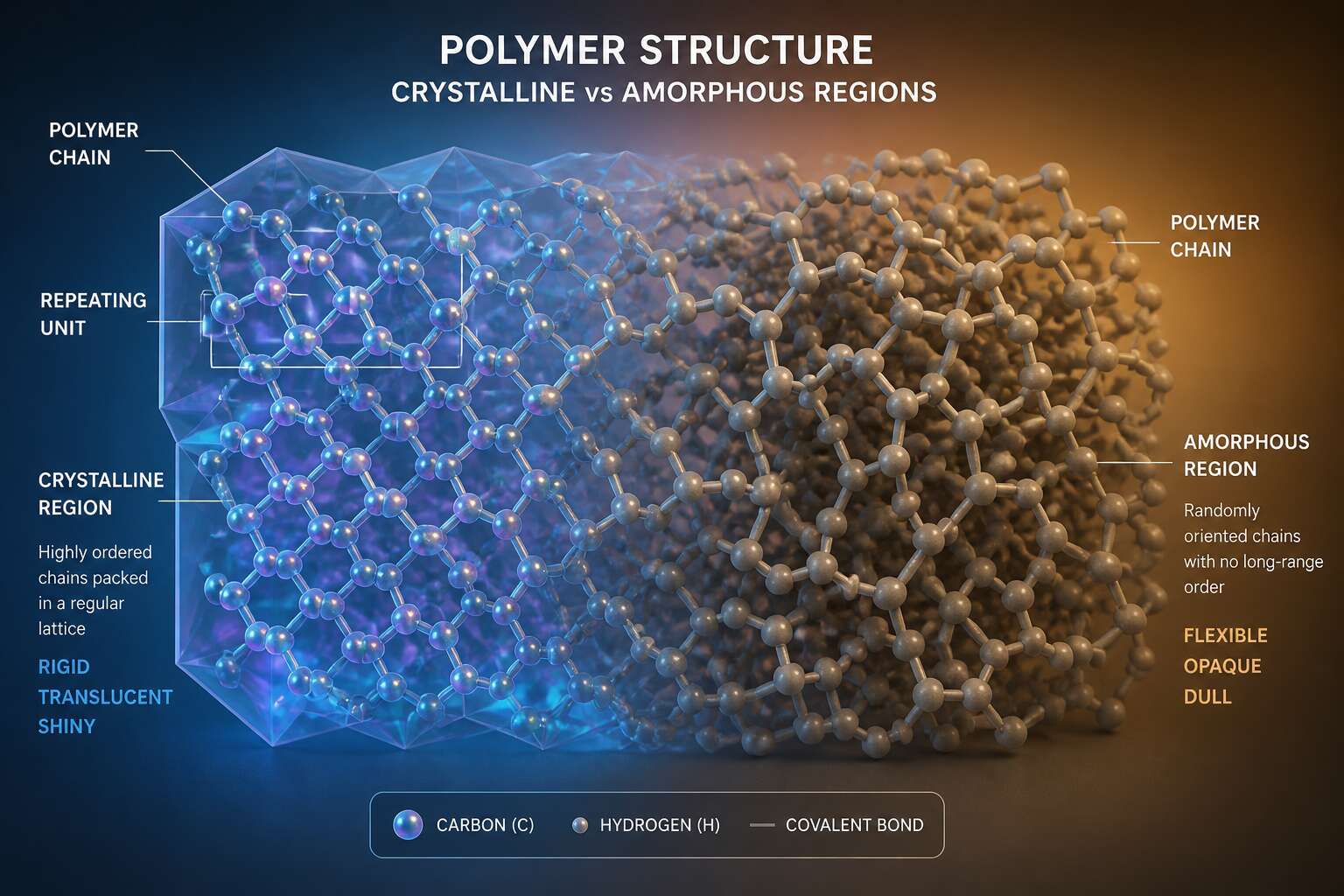
Most people assume that all plastics are amorphous blobs, but the reality is far more nuanced. The question of whether polymers are crystalline doesn’t have a simple yes or no answer. Instead, it depends entirely on the molecular architecture and the conditions under which the material was processed. Many polymers are semi-crystalline, meaning they possess both ordered, rigid regions and disordered, flexible zones.
Think of a bowl of tangled spaghetti, but with a few perfectly aligned bundles mixed in. Those aligned bundles are the crystalline regions, providing strength and stiffness. The tangled parts are amorphous, offering toughness and impact resistance. This dual nature is what gives materials like polyethylene and nylon their remarkable versatility, allowing them to be both durable and flexible. When a polymer cools from a melt, the chains don’t have time to perfectly arrange themselves, leaving a mixed state.
Several factors dictate how much crystallinity a polymer will achieve:
– Chain regularity: Polymers with simple, uniform repeat units, like high-density polyethylene, can pack tightly.
– Side group size: Bulky side groups, such as those in polystyrene, hinder the packing process, leading to largely amorphous materials.
– Cooling rate: Slow cooling gives chains more time to organize, increasing crystallinity, while rapid quenching traps them in a disordered state.
So, are polymers crystalline? They often are, but rarely completely. This balance between order and chaos is precisely what engineers manipulate to create specific properties. The degree of crystallinity directly influences clarity, melting point, and chemical resistance, making it a crucial factor in everything from packaging films to automotive parts. Understanding this structural duality is key to designing the next generation of high-performance materials.
Critical Factors That Determine Polymer Crystallinity
Ask a materials engineer the question, are polymers crystalline, and you will get a nuanced answer. In my experience, most polymers are semi-crystalline at best, and the degree of order depends on several critical factors that govern how chains pack together.
Chain architecture is the first factor. Linear polymers with regular repeating units crystallize more readily than branched or crosslinked ones. Stereoregularity also matters, because isotactic or syndiotactic arrangements allow chains to form orderly lattices, while atactic configurations remain amorphous.
- Cooling rate: slow cooling gives chains time to align, fast cooling traps them in disorder.
- Molecular weight: shorter chains move easily, but longer chains tangle and resist crystallization.
Nucleation agents and processing conditions also influence the outcome. So when you ask are polymers crystalline, remember that it is not a simple yes or no. It is a question of how much order you can achieve in a given material!
Physical Properties of Crystalline vs. Amorphous Polymers
Crystalline order in polymers is never absolute. To ask are polymers crystalline is to ask about the balance of ordered and disordered phases. That balance shapes every physical property.
Crystalline regions melt at a defined temperature. Amorphous regions soften across a range. This difference dictates processing and use. For example, high density polyethylene has strong crystallinity, while atactic polystyrene remains amorphous. Their responses to heat and stress diverge sharply.
A useful comparison:
- Crystalline polymers exhibit higher tensile strength and rigidity.
- Amorphous polymers offer better transparency and impact resistance.
Thus, the answer always depends on the specific polymer and its thermal history. No polymer is perfectly crystalline or perfectly amorphous.
How to Measure and Characterize Polymer Crystallinity
The question “are polymers crystalline” does not have a simple yes or no answer. Most polymers are actually semi-crystalline. They possess a fascinating dual nature, containing both ordered, rigid crystalline regions and disordered, flexible amorphous zones. Imagine a cooked spaghetti dish; some strands lie perfectly straight and packed together, while others are tangled and loose. That contrast defines the microstructure.
Measuring this balance is crucial for engineering applications. Understanding the degree of crystallinity tells us how a material will perform. It dictates stiffness, impact resistance, and even transparency. For South African manufacturers producing everything from automotive components to food packaging, this data is essential for quality control.
To quantify this property, scientists use several techniques. Differential Scanning Calorimetry (DSC) measures the heat flow associated with melting. X-ray diffraction (XRD) analyses the scattering patterns of the crystal lattice. These methods help engineers predict precisely how a product will behave under stress.
The answer to “are polymers crystalline” is ultimately about understanding structure-property relationships. It is a delicate dance between order and chaos at the molecular level. Mastering this dance allows us to create materials that are both tough and flexible, tailored to the specific demands of our environment. It is a profound scientific narrative.
Industrial Implications and Real-World Applications of Crystalline Polymers
When engineers ask themselves, are polymers crystalline, the answer fundamentally dictates their material choice. The degree of crystallinity determines whether a component will flex under pressure or snap. In demanding sectors like automotive and aerospace, predictable performance is non-negotiable, and that predictability stems from the polymer’s internal order.
This structural arrangement, or lack thereof, has direct industrial consequences. Take high-density polyethylene, for instance. Its higher crystallinity affords superior chemical resistance and stiffness, making it ideal for robust piping systems. Conversely, a more amorphous variant offers clarity, which is perfect for packaging films. The decision is a trade-off between impact strength and thermal resilience.
The practical applications are widespread across South African industries:
- Polypropylene in automotive parts, where fatigue resistance is paramount.
- PET in beverage bottles, valued for its gas barrier properties.
- Nylon in textiles and engineering components, offering high tensile strength.
These materials are not just theoretical curiosities. Polyether ether ketone, or PEEK, with its high crystallinity, survives in the harsh environments of downhole oil drilling. Without this ordered molecular architecture, these components would soften and fail. For the local manufacturer, understanding the crystalline nature of a resin is the difference between a durable product and a costly recall.

0 Comments