Understanding Saccharide Chains
Defining Homopolysaccharides and Their Monomeric Units
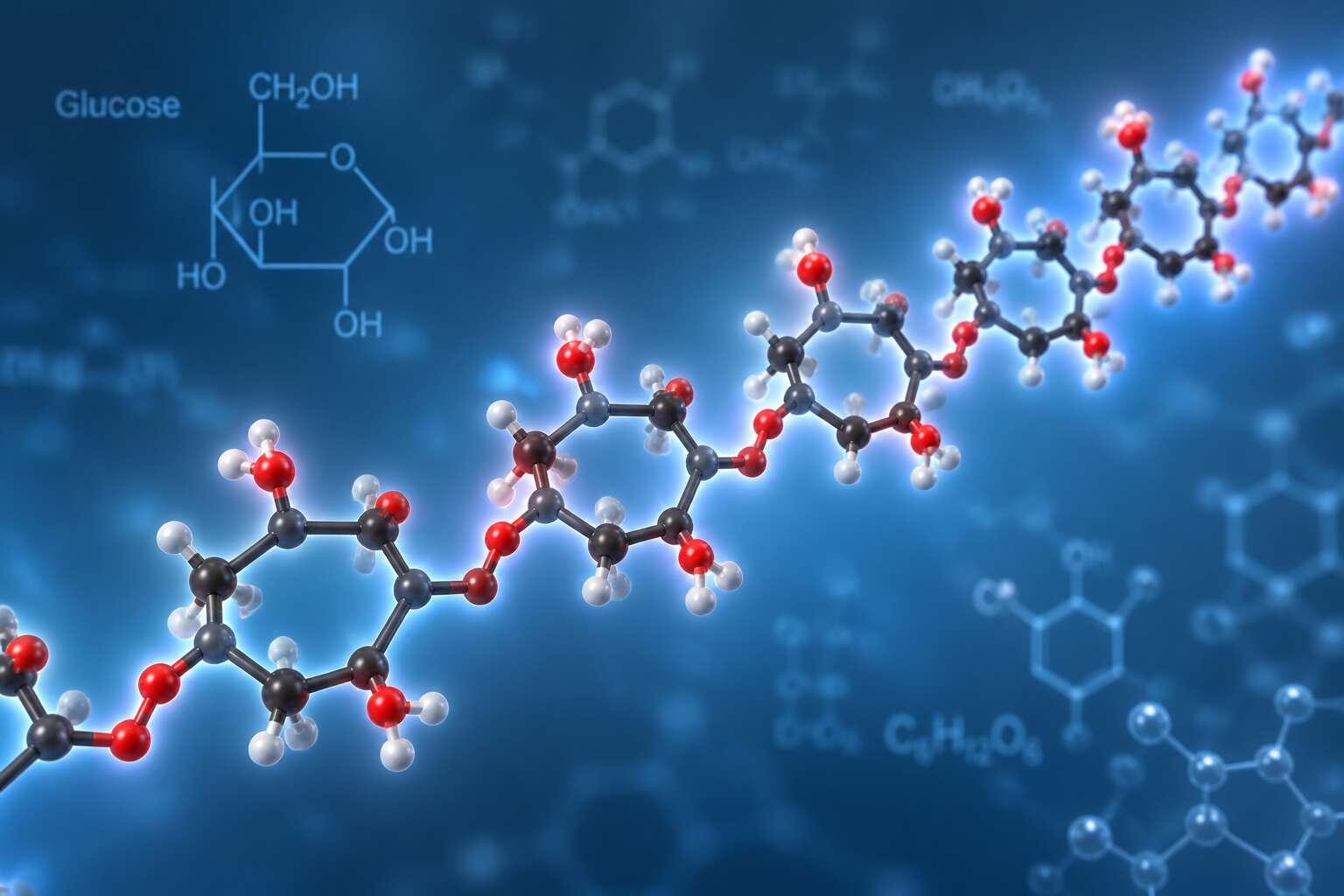
Glucose molecules can assemble into chains with unexpectedly different properties. Cellulose and starch both use the same monomer, yet their roles diverge completely. I find it fascinating that this defines homopolysaccharides, which are polymers glucose built from one repeating sugar unit.
The linkage type determines behaviour. Alpha bonds offer flexibility and digestion, while beta bonds create rigidity. Common homopolysaccharides include:
- Amylose with linear alpha chains
- Glycogen with branched alpha chains
- Cellulose with linear beta chains
Branching adds complexity. Glycogen’s many branches allow rapid glucose release, a crucial adaptation for active animals!
Key Glycosidic Linkages: Alpha vs. Beta Configurations
The orientation of a single oxygen atom separates the food we absorb from the fibre we pass. In alpha glycosidic linkages, the oxygen points downward, creating a bend that human enzymes can hydrolyse. Beta linkages flip that oxygen upward, producing straight, crystalline chains that resist our digestive system. This is not a minor chemical nuance; it is a biological divergence.
- Alpha bonds: flexible, trigger enzyme activity
- Beta bonds: linear, offer structural stability
These configurations explain why polymers glucose behave so differently across species. Ruminants possess symbiotic microbes that fracture beta bonds, granting them access to cellulose. We lack that capability! Our evolutionary path chose alpha bonds for energy storage, leaving beta bonds as structural support in plant cells. The same monomer, ignored or embraced, determines survival.
Branching Patterns and How They Affect Structure
Consider glycogen and amylopectin. They are both polymers glucose, but their branch points differ. Amylopectin branches every 24 to 30 residues. Glycogen branches every 8 to 12. That density changes everything. A highly branched chain exposes more non-reducing ends, which enzymes attack simultaneously. This is why glycogen releases glucose faster than starch can.
Branching also alters physical structure. Branched chains do not pack tightly, so they remain amorphous and water-soluble. Unbranched chains, like amylose, form helical complexes and precipitate. For South African brewers, this determines whether your wort becomes hazy. For food chemists, it controls the mouthfeel of sorghum porridge.
Here is the key insight:
- Branching increases solubility.
- Branching accelerates enzymatic hydrolysis.
- Branching lowers gelation temperature.
I find this remarkable! Organisms adjust energy storage without changing the monomer itself.
Comparing Storage Polysaccharides and Structural Polysaccharides
Polymers glucose serve two opposing functions. Storage polysaccharides release energy quickly. Structural polysaccharides provide durable support. The same monomer becomes either quick energy or permanent structure. For humans, this contrast determines digestibility. I find it remarkable that one glycosidic bond controls that outcome. Cellulose chains pack into rigid sheets. Chitin adds nitrogen to increase toughness. Storage chains like glycogen remain branched and water-soluble, ready for enzymatic breakdown!
- Storage chains hydrate and dissolve in water.
- Structural chains resist water and form crystals.
- Human enzymes break storage chains but not structural ones.
This is why maize meal nourishes, while maize stalks pass through. The same monomer yields both energy and structure.
Biological Roles of Glucose-Based Macromolecules
Glycogen in Animals: Energy Reservoirs and Muscle Function
Glycogen constitutes up to 10% of the liver’s mass, a remarkable reserve for any molecule. In animals, this branched molecule serves as an energy store, built from polymers glucose arranged for rapid release. Enzymes strip terminal glucose units in milliseconds, making glycogen a dynamic fuel source.
Muscle glycogen works locally, powering sprints and heavy lifts. The liver supplies systemic glucose instead. Your body follows clear rules:
- Muscle glycogen stays put for ATP.
- Liver glycogen enters circulation.
- Insulin and glucagon govern both.
This architecture ensures energy is accessible exactly when needed.
Starch in Plants: Amylose and Amylopectin Dynamics
In the botanical world, starch is the quiet miracle of stored sunshine, a chain of polymers glucose that fills the endosperm with potential energy. Unlike the swift, animal-driven breakdown of glycogen, starch is a deliberate, patient reserve. Within a single grain, two distinct molecules co-exist, each telling a different story of survival and time.
Amylose is the unadorned linear thread, its helical structure coiling tightly through the granule. This molecule resists rapid dissolution, offering a slower release of energy. In contrast, amylopectin erupts with a torrent of branching, its short chains resembling a fragrant cluster of jasmine on a vine. The granular architecture is vital, and the ratio of these parts dictates a food’s texture, from the firm bite of boiled rice to the feathery fluff of a baked potato.
Herein lies a critical distinction for botanists and bakers alike:
– Amylose is truly soluble, forming a gel when cooked.
– Amylopectin remains insoluble, creating a viscous paste.
– Amylose is roughly twenty to thirty percent of the granule.
– Amylopectin dominates the remaining mass, giving potatoes their floury heart.
The profound consequence of these two structures appears in the mouthfeel of South African staples like mieliepap. The swelling of the granules during cooking determines whether the meal is a dense, hearty base for chakalaka or a delicate, smooth porridge. Plants assemble their store of polymers glucose not as a single compound, but as a masterpiece of tailored energy, ensuring that the seed has the means to resurrect itself before the next season’s rain.
Cellulose as a Structural Framework in Plant Cell Walls
Every blade of grass and stalk of maize owes its upright stance to cellulose, one of the polymers glucose forms through beta glycosidic bonds. These chains align into microfibrils, weaving a crystalline lattice that resists tension and compression. Plant cell walls rely on this scaffold to maintain shape, channel water, and protect internal tissues.
Unlike the digestible starch in a mielie kernel, cellulose remains indigestible to humans because our enzymes cannot cleave its beta linkages. In South African soils, this same polymer gives fibrous grasses their toughness and allows trees like the acacia to withstand dry winds. The structural payoff is immediate:
- Cellulose is insoluble and chemically inert.
- It forms hydrogen bonds between adjacent chains, creating high tensile strength.
- Its orientation within cell walls dictates growth direction.
This framework stands in direct contrast to energy storage, proving that polymers glucose can serve architecture as faithfully as they serve metabolism.
Chitin and Chitosan: Modified Sugar Chains in Nature
Hard shells of a Cape rock lobster and the resilient cell walls of a mushroom share a secret: they rely on a nitrogen modified form of polymers glucose called chitin. This material replaces cellulose in many invertebrates and fungi, offering structural rigidity without the costly energy of continuous repair.
Chitin arranges in crystalline microfibrils, but its acetyl groups allow tighter packing than cellulose. When deacetylated, chitin becomes chitosan, a molecule with exposed amino groups that bind toxins and microbes. South African researchers study chitosan from shrimp waste for wound dressings, since it promotes clotting and resists infection. What fascinates me is how a single chemical tweak shifts a structural polymer into a bioactive one!
- Chitin provides exoskeleton strength in insects and crustaceans.
- Chitosan dissolves in weak acids, enabling films and gels.
These modified chains illustrate how polymers glucose adapt beyond energy and support, taking on roles that intersect chemistry with biology.
Dextran and its Role in Biofilms and Medical Research
In the sticky world of biofilms, dextran creates the structural glue. This polymers glucose chain, produced by Streptococcus mutans, builds the matrix that anchors dental plaque. Medical researchers harness dextran for its biocompatibility, using it in blood plasma substitutes and drug delivery systems.
- Dextran-based hydrogels for wound dressings
- Dextran sulfate as an anticoagulant
- Cross-linked dextran for size-exclusion chromatography
What fascinates me is how this bacterial product becomes a healing tool. Depending on the strain, dextran ranges from linear to highly branched, altering its solubility and function. This adaptability shows how nature repurposes the same glucose building blocks.
Industrial Applications of Starch and Cellulose Derivatives
Biodegradable Plastics and Packaging from Polysaccharides
Plastic made from plants is no longer a lab curiosity. Starch derivatives, modified through heat and pressure, now form the backbone of compostable cutlery and food trays. Cellulose, the most abundant organic compound on Earth, gets transformed into transparent films that rival petroleum-based cling wrap. These polymers glucose, when chemically tweaked, offer mechanical strength without the environmental guilt.
Consider the packaging landscape:
– Cassava-based bags dissolve in water
– Cellulose acetate wraps break down in industrial composters
– Starch-polyester blends handle hot liquids without melting
South African retailers are testing these materials for fresh produce. The challenge remains cost and moisture resistance. But the shift from fossil fuels to renewable feedstocks is accelerating, driven by consumer pressure and municipal waste bans.
Thickeners, Stabilizers, and Gelling Agents in Food Processing
In South African food factories, modified starch and cellulose derivatives quietly determine the mouthfeel of everything from creamy muesli to tangy chutney. These polymers glucose are not exotic compounds; they are everyday ingredients.
Crosslinked starch resists the high heat and shear of retort processing. Cellulose ethers, such as methylcellulose, form thermal gels that hold shape when hot and dissolve when cold. This duality lets manufacturers create plant-based patties that bind without eggs.
Stabilizers work differently. Carboxymethyl cellulose prevents ice crystal growth in frozen desserts. Hydroxypropyl starch keeps salad dressings emulsified for months.
- Pregelatinized starch for instant soups
- Cellulose gum for low-fat yoghurt
- Modified tapioca for fruit pie fillings
These polymers glucose also enable texture modulation, so a sauce can be thick yet pourable! The result is consistent quality regardless of batch or season.
Pharmaceutical Excipients and Controlled-Release Matrices
When a tablet releases medicine over twelve hours, a starch or cellulose derivative often makes it possible. These polymers glucose derivatives are pharmaceutical excipients, acting as delivery architects. They decide whether a drug dissolves in the stomach or the intestine.
Controlled-release matrices use hydrophilic polymers glucose like hydroxypropyl methylcellulose. The polymer hydrates, forming a gel layer the drug must cross. Crosslinked starch acts as a superdisintegrant, pulling water in so tablets break apart quickly.
Common functions in a single formulation:
– Binder: microcrystalline cellulose holds granules together.
– Matrix former: methylcellulose controls release.
– Coating: hydroxypropyl starch shields moisture-sensitive actives.
The polymer glucose backbone and its substitution pattern change everything. Viscosity grade and particle size alter release profiles. These are standard tools for South African formulators.
Textile and Paper Industries: Coating and Sizing Solutions
Textile and paper mills lean on modified starches and cellulose ethers that are, at their core, polymers glucose tailored for industrial endurance. In textile sizing, these derivatives form a tensile film around yarns, cutting breakage rates on high speed looms. Oxidized or hydroxyethyl starches deliver the exact viscosity needed for uniform pickup without stiffening the fabric. I have seen a batch of cotton warp fail solely because the sizing agent’s molecular weight distribution was off.
Paper coating tells a similar story. Carboxymethyl cellulose and hydroxypropyl starch control water retention, binding pigments and preventing binder migration during calendering. The result is a smooth, printable surface that also resists ink bleed. Yet the substitution pattern and degree of etherification dictate everything, from film flexibility to repulpability.
- Surface sizing controls porosity and ink holdout
- Internal sizing adds wet strength
- Coating binders improve gloss and pick resistance
These polymers glucose derivatives are not flashy, but they quietly determine whether a cardboard box survives a humid Durban warehouse or a yarn lot weaves without snapping.
Bioethanol Production Through Hydrolysis and Fermentation
South Africa’s sugar belt produces molasses in bulk. Yeast cells thrive on polymers glucose released from starch and cellulose after hydrolysis. In bioethanol production, acid or enzyme cocktails shorten these polymers glucose chains into fermentable monomers. Yeast then ferments the syrup into ethanol. The leftover lignin becomes process heat. Efficiency depends on the source. Cane molasses ferments easily, while woody biomass requires pretreatment.
Here is a simple breakdown of the hydrolysis steps:
1. Liquefaction: starch slurries are gelatinized and thinned.
2. Saccharification: glucoamylase trims polymers glucose into glucose syrup.
3. Fermentation: yeast converts glucose to ethanol.
Distillation concentrates the alcohol to fuel grade. Each step relies on the same glycosidic chemistry that makes starch and cellulose useful.
Analytical Methods for Characterizing Glycosidic Macromolecules
Spectroscopic Techniques: FTIR and NMR in Structural Analysis
A single NMR spectrum can resolve the position of every carbon atom in a glycosidic ring. That level of precision matters because the structural nuances of polymers glucose determine their industrial behaviour, from viscosity contributions to film formation. Fourier transform infrared spectroscopy (FTIR) offers the faster read, detecting vibrational transitions of glycosidic bonds and distinguishing alpha from beta configurations without elaborate sample preparation.
For complex polysaccharides, neither method stands alone. FTIR quantifies functional group modifications such as acetylation or sulphation, while two-dimensional NMR maps branching points and sequence arrangements.
- FTIR: detects ester carbonyl stretches and phosphate substitutions
- NMR: assigns anomeric protons and quantifies linkage distribution
I have often relied on both techniques in tandem, and the complementary results consistently expose details that individual spectra obscure.
Chromatographic Approaches for Molecular Weight Distribution
Chromatography separates polymers glucose by physical dimensions. Size exclusion chromatography (SEC) sorts molecules by hydrodynamic volume, with smaller chains emerging later. The resulting molecular weight distribution predicts whether your polysaccharide will thicken a sauce or form a rigid gel. I pair SEC with multi angle light scattering to obtain absolute molar mass, avoiding the guesswork of elution time alone.
- Refractive index detectors measure concentration.
- Viscometry tracks hydrodynamic volume.
- Light scattering delivers true mass.
These data expose batch variation hidden in viscosity readings. For industrial polymers glucose, a skewed distribution explains why one batch flows and another clumps. That nuance often escapes FTIR and NMR, which focus on connectivity rather than chain lengths.
Enzymatic Assays to Determine Degree of Polymerization
Enzymatic assays pin the degree of polymerization to a precise number. For polymers glucose, the method relies on enzymes such as amyloglucosidase to release terminal glucose units one at a time. The resulting reducing sugar concentration, measured colorimetrically, reveals the average chain length. This complements chromatography by directly quantifying enzyme accessibility.
I often use a combination of enzymes to distinguish linear from branched regions. Pullulanase cuts alpha-1,6 linkages, while beta-amylase attacks alpha-1,4 bonds from the non-reducing end. Comparing the glucose released before and after debranching gives structural insight.
X-Ray Diffraction and Crystallinity Assessment
X ray diffraction doesn’t lie. When investigating polymers glucose, this technique reveals the structural grammar hidden within the material. By measuring how X rays scatter off a sample, we can determine whether the molecular chains are packed into orderly crystalline lattices or exist in a more disordered, amorphous state.
Crystallinity is not an all or nothing property. Most glucose polymers display a semi crystalline character, where ordered and disordered zones coexist. The diffraction pattern produces sharp peaks for crystalline regions and broad halos for amorphous areas. I find the ratio between these signals gives us a powerful indicator of material behavior.
An X ray diffractogram can tell us several things about a sample:
– The percentage of crystalline versus amorphous regions
– The size of the crystallites within the matrix
– How the chains align after processing treatments
Moisture content also shifts the diffraction profile. Hydrated regions often show enhanced crystallinity, which directly influences how a polymer degrades or absorbs water. For applications requiring strength and low permeability, higher crystallinity is desirable. For biofilms or controlled release systems, we often need the opposite. This measurement lets us predict performance without guessing.
Thermal Analysis: DSC and TGA for Material Stability
Thermal analysis cuts through guesswork! When assessing polymers glucose, differential scanning calorimetry (DSC) and thermogravimetric analysis (TGA) reveal how heat transforms material stability. DSC measures energy uptake during phase transitions, while TGA tracks mass loss as samples decompose. For polymers glucose, these techniques answer critical questions:
- At what temperature does the polymer soften or degrade?
- How much bound water remains in the matrix?
- Does the material resist thermal oxidation?
A sharp melting endotherm signals consistent chain packing. A broad exotherm may indicate crosslinking. TGA curves often expose residual moisture, which accelerates hydrolysis. I find the combination indispensable. Without thermal data, we are blind to processing limits and shelf life. This is how we predict performance before production.
Microscopy Methods for Morphological Visualization
Most people never see a polymer’s true personality. Under a scanning electron microscope, polymers glucose display wrinkles, pores, and fracture lines that dictate how they dissolve, swell, or degrade. These morphological features matter more than average molecular weight alone.
Optical microscopy reveals birefringence patterns in crystalline regions. Transmission electron microscopy peers into lamellar stacks. Atomic force microscopy maps surface adhesion at the nanometre scale.
- Polarized light microscopy for spherulite size.
- Cryo-SEM for frozen, hydrated specimens.
- Confocal Raman microscopy for chemical distribution.
Each technique captures a different layer of reality. When I photograph starch granule surfaces, the tiny indentations explain why water uptake varies. For chitin, the layered structure exposes how enzymes penetrate. Visualising these shapes turns abstract chemistry into concrete engineering.
Sustainability and Future Perspectives in Saccharide-Based Materials
Renewable Sources and Circular Economy Considerations
South Africa discards millions of tonnes of agricultural residue every year. Those streams contain polysaccharides that can be refined into polymers glucose, creating new value. The shift toward a circular economy depends on viewing waste as feedstock, not simply refuse.
Biorefineries are becoming more common elsewhere. I see clear parallels for our agricultural heartlands. Local adoption could transform material flows across the country. Sugarcane bagasse, maize stover, and processing leftovers all hold promise.
A functional circular system requires several components:
- Aggregation of biomass from dispersed farms
- Hydrolysis using enzyme cocktails
- Polymerisation into saccharide based products
- Recovering side streams for energy or soil
Each component needs investment and coordination. Polymers glucose derived from renewable sources offer a tangible route to reduce reliance on virgin inputs. South African stakeholders should focus on pilot infrastructure and regional partnerships.
Enzymatic and Chemical Modifications for Advanced Functionality
Enzymatic and chemical modification of saccharide-based materials is rewriting what these biopolymers can do. I have seen selective oxidation and esterification turn rigid chains into adaptive networks for filtration membranes and controlled-release systems. This is where polymers glucose research earns its keep. Polymers glucose chemistry is precise. The sustainability payback is real.
New enzyme cocktails now attach functional groups without harsh solvents. These biocatalysts operate under mild conditions, cutting energy use and waste. Some routes even recycle the catalyst.
- Phosphorylation introduces flame retardancy
- Sulfation creates heparin-like bioactivity
- Carboxymethylation improves water solubility and film clarity
The future lies in stacking these modifications. A single backbone can carry multiple functional groups, each tuned for a specific application. South African research institutions have the raw materials and the expertise. What they need is scaling. The next decade will decide whether polymers glucose derivatives remain laboratory curiosities or become industrial workhorses.
Biomedical Innovations: Hydrogels, Wound Dressings, and Drug Delivery
Polymers glucose are reshaping biomedical innovation, and their sustainability profile is the main attraction. In South Africa, the shift from petrochemical plastics to renewable saccharide hydrogels could cut clinical waste significantly. I have observed small batch production of wound dressings using local cellulose, yet the sector needs consistent supply chains to compete.
Future perspectives depend on processing efficiency. Water based synthesis and enzymatic catalysts reduce the carbon footprint, but scale up remains a bottleneck. For drug delivery, polymers glucose must prove reproducible release rates. That requires robust quality control, not experimental luck.
- Feedstock from agricultural residues rather than food crops
- Solvent recovery systems for industrial reactors
- Life cycle assessments tailored to South African conditions
The next decade will separate laboratory promises from clinical realities. If production costs align with existing materials, these biopolymers can become standard care!
Challenges in Large-Scale Production and Cost-Effectiveness
Scaling saccharide-based materials from laboratory batches to industrial volumes remains the steepest climb. I have watched promising polymers glucose fail not on chemistry, but on economics. The raw inputs are renewable, yet processing costs often exceed petrochemical counterparts.
For South African manufacturers, three barriers dominate. Feedstock logistics, energy input, and quality consistency. Agricultural residues are abundant, but collection and pretreatment demand infrastructure that barely exists.
- Capital costs for enzymatic reactors
- Water recovery systems in arid regions
- Certification for medical grade outputs
Future viability depends on whether polymers glucose can achieve cost parity. Life cycle assessments will guide investment, but without cheaper processing, clinical adoption stalls. The next decade must prove production efficiency, not just sustainability. That is the real test!
Emerging Research on Nanocellulose and Sugar-Based Nanocomposites
Sugarcane waste in Mpumalanga now feeds a pilot line producing cellulose nanocrystals. These structures, smaller than a wavelength of light, exhibit exceptional tensile strength. For manufacturers of polymers glucose, the shift means rethinking waste as a resource. The nanocrystals do not replace glucose monomers; they reinforce the final composite.
Research at the Council for Scientific and Industrial Research (CSIR) pairs these nanowhiskers with starch-based films. A 1% loading reduces water vapor transmission by 30%, a measurable gain for arid-region packaging. Sugar-based nanocomposites also degrade faster in landfill tests, addressing the nastiest part of plastic pollution. The future hinges on scaling this integration while keeping costs below petroleum-derived rivals.

0 Comments