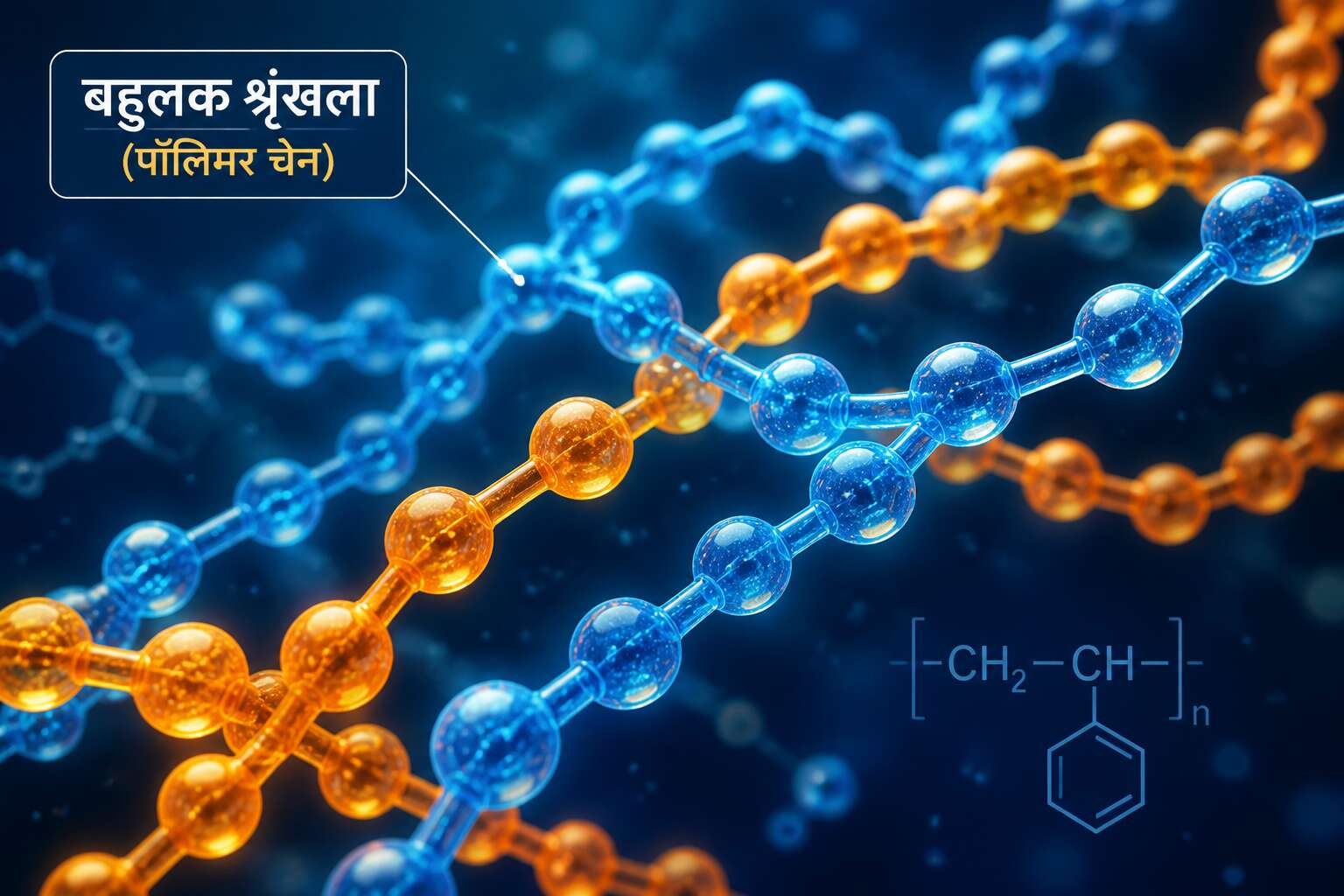
What Exactly Are Polymers?
Defining Polymers in Simple Words
Every plastic bottle, every strand of DNA, and every drop of latex paint contains polymers. These long chains of repeating molecules are fundamental to modern manufacturing. For Hindi speakers, the scientific term carries the same weight, and understanding polymers ka hindi meaning provides access to a global vocabulary of materials science.
A polymer forms when monomers bond in repeated sequences. The chain length and branching determine whether the material behaves as a flexible rubber or a rigid shell. Natural polymers include cellulose and silk. Synthetic polymers include nylon and polyethylene.
Common polymer traits:
– Large molecular structure
– Repeated subunit patterns
– Adjustable strength and flexibility
These traits explain why polymers dominate industries from automotive parts to medical implants.
The Science Behind Polymer Chains
Polymer chains are built through polymerization, where monomers connect at reactive sites under heat or pressure. The length and weight distribution of the resulting chains control how the material behaves, whether it flows as a viscous liquid or holds rigidly in place. Chain architecture generally falls into three categories:
- Linear chains, which pack tightly and create strong, crystalline materials.
- Branched chains, which leave gaps and produce softer, more flexible plastics.
- Cross-linked chains, which bond to each other and form networks that resist melting.
Cross-linking transforms a thermoplastic into a thermoset. In my experience, this distinction is the first thing a production engineer checks when a polymer part fails unexpectedly!
Understanding polymers ka hindi meaning is understanding this molecular architecture. The term captures multiple repeating units forming one coherent material. For manufacturers in South Africa, this vocabulary is practical, translating directly to performance under high UV exposure or fluctuating humidity.
Natural vs Synthetic Polymers
Your clothes, your car tyres, your water pipes. I rarely stop to wonder where they come from. Every polymer traces back to one of two origins. Natural polymers like cotton, wool, and natural rubber have served humanity for centuries. Synthetic polymers emerged from petroleum chemistry in the last century.
Natural polymers degrade faster and behave unpredictably under heat. Synthetic polymers offer consistency but raise disposal questions. The difference matters more than most realise. I have watched South African engineers weigh these tradeoffs daily, from packaging in Johannesburg to agricultural films in the Free State.
Understanding polymers ka hindi meaning connects these ideas. The phrase describes any large molecule built from repeating units. Whether your source is a tree or a refinery, the outcome follows the same definition.
Natural versus synthetic:
- Natural polymers: renewable, biodegradable, variable quality.
- Synthetic polymers: consistent, durable, dependent on fossil fuels.
Why Polymers Matter in Daily Life
Consider the first object you touched this morning. It was likely a polymer. The polymers ka hindi meaning, large molecules built from repeating units, undersells their quiet authority. In South Africa, polymer applications range from geotextiles stabilizing roadways in Gauteng to drip irrigation piping in Western Cape vineyards.
A short inventory of daily encounters might include:
- water bottles
- cellphone casings
- shoe soles
- food packaging
These artefacts share one trait: they derive from repeating molecular chains. Though they feel ordinary, each solves an engineering problem. The phone case absorbs impact. The water bottle prevents contamination. The material foundations of daily existence are polymer science, visible once you start looking.
Polymers in the Hindi Language
Common Hindi Terms for Polymer Types
South African scientists rarely pause to consider how Hindi names shape polymer research. The phrase polymers ka hindi meaning reveals a technical vocabulary built on Sanskrit roots. I have watched researchers stumble over these terms in translated journals. Hindi uses ‘prakritik polimer’ for natural materials and ‘sanlekhit polimer’ for synthetic alternatives.
Common Hindi terms worth remembering:
- Ekak for monomer
- Shrinkhala for chain
- Tapasthayi polimer for thermoplastic
- Tapakathor polimer for thermosetting plastic
The academic word ‘bahulak’ also appears in Hindi chemistry textbooks alongside ‘polimer.’ This linguistic precision helps South African students reading Hindi scientific literature, transforming confusing passages into clear meaning!
How Hindi Textbooks Explain Polymers
Open a Hindi chemistry textbook and you will find polymers taught as a systematic topic. The term “bahulak” appears early, with the text emphasising how small units assemble into enormous molecules. Hindi textbooks rarely dwell on English translations. They move directly into the logic of bonding, using simple diagrams and repetition.
One notable feature is how Hindi textbooks order the material.
- First, they define the repeating unit.
- Then, they show how units join.
- Finally, they classify the resulting chain.
This sequence follows the progression of understanding. For a South African reader, grasping the polymers ka hindi meaning in textbook form yields greater clarity than dictionary definitions alone.
Translating Polymer Jargon for Students
Translating polymer jargon for Hindi medium students requires more than substituting English words with Hindi equivalents. The phrase polymers ka hindi meaning often leads to “bahulak”, but understanding related vocabulary is equally important. Students encounter terms that describe molecular behaviour, not just names for materials.
Consider how the vocabulary divides:
– “Eakaki” for monomer, or the single unit
– “Bahulakan” for the polymerisation process itself
– “Shrinkhala” for the chain that forms between units
These renderings help learners visualise what happens at a molecular level. When a teacher explains that “bahulak” literally means “many units”, the abstract concept becomes tangible. I have seen students grasp the idea faster when they understand the root words. For South African readers exploring Hindi science education, these translations reveal how language shapes scientific understanding. The jargon carries the logic of the chemistry within it.
Regional Variations in Hindi Terminology
In Mumbai, a textbook might call a polymer “bahulak”, while in Lucknow the same word is spoken with a different cadence. Regional variations in Hindi terminology for polymers affect how students decode the science. I have seen a teacher in Varanasi use “sanglan” for chain, while a colleague in Jaipur prefers “shrinkhala”. This diversity is practical.
- “Eakaki” for monomer in central India
- “Guthika” for unit in the east
- “Bahulakan” for polymerisation in the north
Each term alters the mental picture a student forms. For a South African reader, understanding polymers ka hindi meaning means acknowledging that Hindi itself is a living, regional language. The core chemistry remains constant, but the vocabulary differs across the subcontinent.
Breaking Down Polymer Classifications
Thermoplastics and Thermosetting Plastics
Plastics refuse to pick a single behavior, which is why students struggle. Thermoplastics soften when heated and harden when cooled, a reversible process. Thermosetting plastics transform only once, so reheating does nothing. In South African classrooms, this technical split often gets mixed up with polymers ka hindi meaning, but knowing the difference saves time.
- Thermoplastics allow reshaped and recycled products.
- Thermosets resist heat and stay rigid permanently.
That rigidity suits electrical fittings, while thermoplastics handle packaging. When your phone charger melts from overuse, you know it was never a thermoset.
Homopolymers vs Copolymers
One polymer chain can hold a single repeating unit or several different monomers. That distinction separates homopolymers from copolymers. Homopolymers, like polyethylene, repeat one block endlessly. Copolymers, such as ABS plastic, combine two or more monomers in a single strand. This pairing changes strength, flexibility, and melting point. For South African learners wrestling with polymers ka hindi meaning, this comparison offers clarity. Instead of memorizing translations, they see how structure dictates behavior.
Consider the practical split:
– Homopolymers give consistent, predictable properties.
– Copolymers allow engineers to tune materials for specific stresses.
That tunability explains why car bumpers use copolymers while water bottles rely on homopolymers. Once you grasp this classification, polymer science stops feeling abstract.
Addition and Condensation Polymers
Most polymers form through two distinct pathways. Addition polymers grow by linking monomers without losing any atoms. Condensation polymers expel small molecules like water as they bond. That simple difference changes how they behave! For South African learners searching for polymers ka hindi meaning, this classification explains why nylon and polyester feel different from polyethylene.
Each route produces unique materials. Addition polymers often resist heat and chemicals. Condensation polymers offer strength and stiffness for engineering uses.
- Addition: PVC, Teflon, polystyrene
- Condensation: Nylon, PET, polycarbonate
Understanding these categories sharpens your grasp of polymer science. The Hindi term adds context, but the real insight lies in how atoms connect.
Biodegradable and Non-Biodegradable Polymers
Half the plastic ever made was created after 2005. That fact matters because plastic does not simply vanish. It waits. Some polymers rot away cleanly, while others persist for centuries. The difference comes down to molecular structure. Biodegradable polymers, like polylactic acid, have weak bonds that microbes can break down. Non-biodegradable polymers, like polyethylene, have strong carbon backbones that resist decomposition. For South African learners exploring polymers ka hindi meaning, this classification helps. Consider the two groups:
- Biodegradable: starch blends, PHA, PBAT
- Non-biodegradable: PVC, PET, nylon
The Hindi phrase clarifies vocabulary. The chemistry decides who lingers.
Examples of Polymers Around You
Plastics and Packaging Materials
Walk into any South African supermarket and you see layers of plastic. Flexible wraps, rigid bottles, and foamed trays all share a common origin. They are polymers, long chains of repeating units. When we explain polymers ka hindi meaning, we often point to these everyday objects. The objects themselves need no translation.
Polyethylene dominates packaging. It forms grocery bags and bread wrappers. Polypropylene appears in bottle caps and takeaway containers. PET, the clear plastic in cold drink bottles, is everywhere in Johannesburg and Cape Town.
Two details escape most shoppers:
- Packaging polymers are chosen for their barrier properties. Oxygen, moisture, and light each require a different polymer blend.
- The same polymer can behave differently based on molecular weight. A thin film and a rigid crate may share the same chemistry.
Understanding polymers ka hindi meaning helps South African students connect local packaging waste to global materials science.
Natural Polymers Like Starch and Cellulose
Open a bag of maize meal and you hold proof of nature’s polymer economy. Starch, made of amylose and amylopectin chains, thickens your morning porridge. Cellulose, the rigid framework of plant cell walls, appears in every leafy green on your plate.
These natural polymers behave differently in daily life. Starch dissolves in warm water and swells, while cellulose stays tough and insoluble. For South African students, the polymers ka hindi meaning of both terms becomes clearer when examining local crops. In Hindi, the idea of “prakritik polymers” applies just as well to sorghum stalks as to pineapple leaves.
- Starch from mealie meal and rice
- Cellulose from butternut skins and citrus peels
- Chitin from mussel shells along the Cape coast
Rubber and Elastomers
Rubber holds a peculiar place in our material world. When I watch a delivery courier’s tyres grip Durban’s rain-slicked roads, I see elastomers doing their quiet work. These polymers return to shape after deformation, a property no other material class replicates. For anyone learning polymers ka hindi meaning, rubber provides the clearest entry point because its behaviour is visible and immediate.
Natural latex from Hevea brasiliensis trees reaches South African factories where it becomes conveyor belts, gaskets, and medical gloves. Synthetic variants like butadiene rubber handle fuel exposure better than natural sources ever could. Different elastomers solve different problems:
- Neoprene wetsuits protecting ocean divers in Cape Town
- Nitrile seals inside automotive engines
- Silicone baking mats in Johannesburg kitchens
Each elastomer responds to stress with temporary compliance, then snaps back. That resilience defines the entire category!
Synthetic Fibers in Clothing
Every garment in your closet tells a polymer story. Polyester dominates fast fashion; nylon reinforces your backpack straps. Acrylic mimics wool without the itch. These synthetic fibers are petroleum derivatives, extruded into threads. That process, in essence, captures polymers ka hindi meaning: long repeating molecular chains.
I once repaired a torn rain jacket with a heat patch. The nylon melted slightly, fusing permanently. That’s a thermoplastic behavior. For Durban’s humidity, breathable synthetics win over cotton. Consider what you wear:
- Polyester in sport jerseys, drying quickly
- Nylon in hiking socks, resisting abrasion
- Spandex in swimwear, stretching 500%
Each fiber’s chemistry dictates its feel. Drawstrings, zipper tapes, even thread. All polymers. Next time you dress, check the label. You’ll see the language of chains.
Polymers in Medical Devices
Your phone case, your car’s dashboard, the non-stick coating on your frying pan. Polymers surround you in forms so mundane you barely notice them! But the same chemistry that makes a water bottle shatterproof also threads through operating theatres. Consider the humble IV drip. The tubing, the catheter, the sterile packaging. All rely on medical grade polymers like PVC and polyurethane. These materials tolerate sterilization, resist bacterial colonization, and flex without fracturing.
In South Africa, where public healthcare demands durability under heavy use, polymer engineering carries real weight. The phrase polymers ka hindi meaning translates to long repeating molecular chains, and those chains pervade medicine. That recognition changes how you see a hospital ward:
- Polyethylene in replacement hip joints
- Polypropylene in surgical mesh
- Silicone in pacemaker insulation
Each polymer selected for its specific interaction with human tissue. Understanding polymers ka hindi meaning, the shared chemistry of long chains, explains why one material suits a hip joint while another suits a pacemaker.
Polymer-Based Paints and Adhesives
Paint on a Johannesburg wall is not merely colour. The binder in water based acrylic paint is a polymer emulsion. As water evaporates, polymer particles fuse into a continuous film. That film grips the surface, resists weathering, and holds pigment in place.
Adhesives follow a similar logic. The glue on a label or the sealant around a shower tray relies on polymer chains that wet the surface, then cure into a strong bond. Consider the everyday things that depend on this chemistry:
- Wood glue in a school workshop
- Masking tape in a painter’s kit
- Epoxy resin in a plumber’s repair
These are tangible examples of polymers ka hindi meaning, the long repeating chains that give coatings and adhesives their grip.
Uses and Applications of Polymers
Polymers in Construction and Infrastructure
Polymers are essential to modern construction and infrastructure. PVC pipes carry drinking water beneath South African streets, while polyurethane foam insulates walls against temperature extremes. These materials perform reliably because polymer chains absorb stress without fracturing.
We see construction teams choosing polymer composites for bridge decks and cladding panels more than ever. These components resist corrosion better than steel and weigh less, reducing transport costs on remote sites. Understanding polymers ka hindi meaning helps engineers appreciate the versatility of these substances.
Common polymer applications in infrastructure include:
- Geotextiles that stabilise road foundations
- Epoxy coatings protecting concrete from chemical damage
- High density polyethylene pipes for stormwater drainage
Each application exploits a different polymer property, from tensile strength to chemical resistance.
Role of Polymers in Electronics
Walk into any electronics repair shop in Johannesburg and you will see the proof. Polymers ka hindi meaning translates to a concept that engineers in India and South Africa apply daily, often without naming it. The plastic casings, the solder masks, and the dielectric layers inside every smartphone all rely on polymer chemistry.
Consider the printed circuit board. The epoxy resin binding its layers must withstand heat, resist moisture, and maintain electrical insulation. Polyimides handle the flexible strips that connect your screen to the motherboard. Conductive polymers now appear in sensors and anti-static packaging.
Common roles for polymers in electronics include:
– Insulating wires and delicate components
– Encapsulating microchips against dust and shock
– Providing lightweight housings for portable devices
These materials do more than protect. They enable miniaturisation. Without them, the slim devices we carry would simply not exist.
Polymers in Automotive and Aerospace
Every modern vehicle owes its fuel efficiency to polymer composites. Engineers replace heavy metal parts with polyamide and polycarbonate components, cutting weight while maintaining strength. The polymers ka hindi meaning becomes clearer when you see dashboards, bumpers, and fuel lines working under extreme heat and vibration.
In aerospace, the stakes rise further. Carbon fibre reinforced polymers form the fuselage sections of commercial jets. These materials endure pressure changes, UV radiation, and temperature swings. An aircraft’s interior, from seat shells to ducting, relies on fire resistant thermoplastics that meet strict safety standards.
Typical applications include:
- Polyether ether ketone for engine components
- Polyurethane foams for cabin insulation
- Epoxy matrices for structural laminates
Environmental Impact and Recycling
Every ton of recycled polymer saves roughly 1.5 tons of carbon emissions. That figure matters in South Africa, where municipal waste streams still carry millions of kilograms of polypropylene and polyethylene to landfills each year. Understanding the polymers ka hindi meaning helps engineers and consumers see these materials as valuable feedstocks, not disposable trash.
Recycled polymers now appear in pavement blocks, irrigation pipes, and shipping pallets. The environmental impact depends on collection systems and chemical stability. Some thermoplastics can be remelted six or seven times before their molecular chains degrade. Thermosets, by contrast, resist reprocessing entirely.
- PET bottles become polyester fibre for blankets and workwear
- HDPE crates become drainage conduits
- LDPE film becomes refuse bags
Future Innovations in Polymer Science
Polymers show up in nearly everything modern, from the soles of your tekkies to the casing of your cellphone. In South Africa, engineers are printing polymer-based components for solar water heaters, cutting costs by nearly 40 percent compared to metal, a number that makes metal suppliers wince! Understanding the polymers ka hindi meaning, or “bahulak” for many-unit substances, helps students grasp why these chains matter in energy storage.
What is coming next? Self-healing polymers that repair microcracks in pipeline coatings. Conductive polymers that bend without breaking, enabling foldable screens and stretchable wiring.
- Polymer batteries for grid storage during load-shedding
- Biopolymer composites pressed from sugarcane bagasse
- 3D printed polymer joints for low-cost prosthetics
These advances shift the focus from disposal to intelligent design.

0 Comments