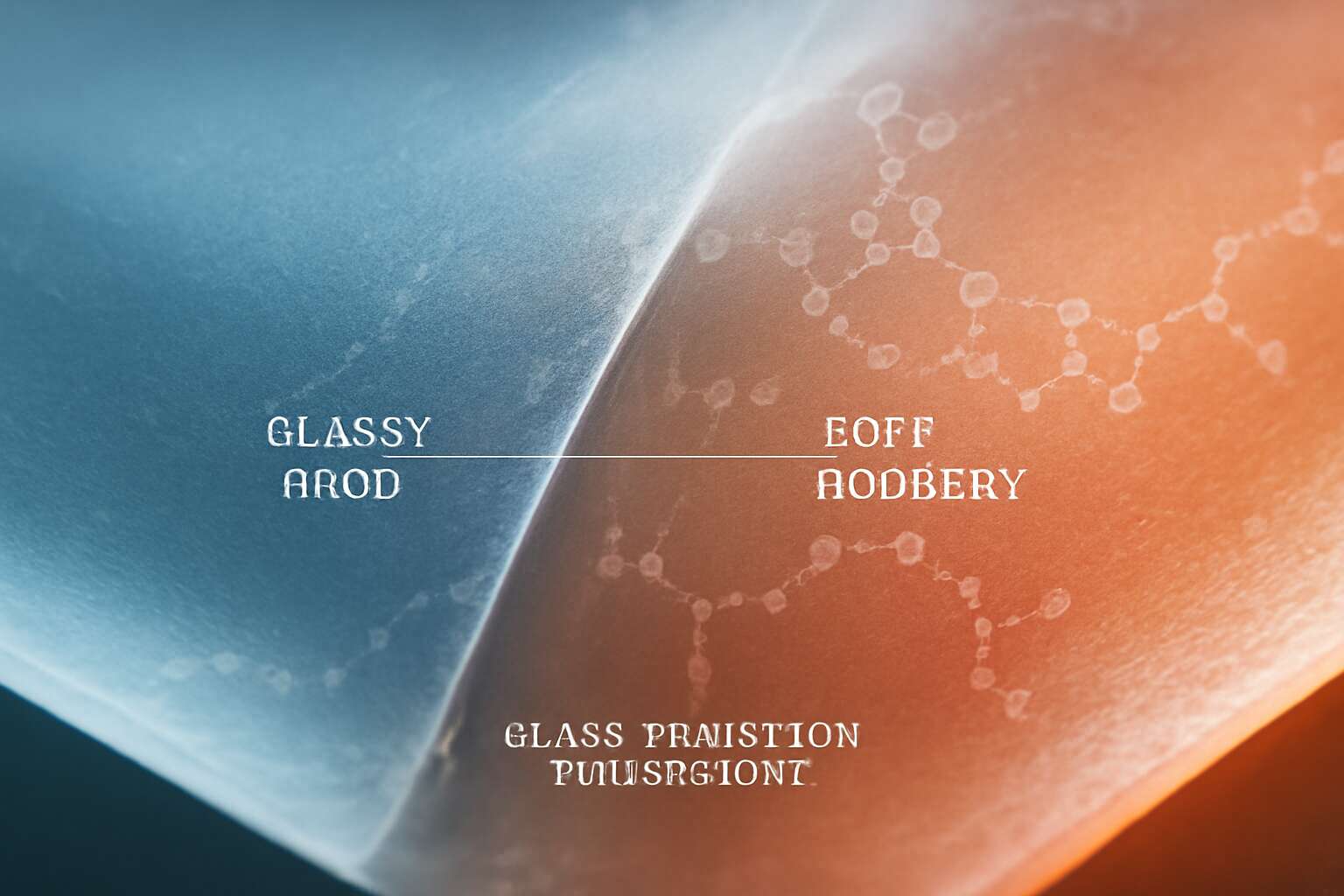
Overview of polymers and glass transition temperature
Definition of glass transition temperature in polymers
In testing labs, more than half of a polymer’s performance surprises cluster around the polymers glass transition temperature. This gatekeeper can determine whether a part stays stiff or surrenders to creep as heat or chill slides past it, shaping the product’s fate with quiet drama!
The glass transition temperature in polymers is the temperature range where amorphous regions shift from a rigid, glassy state to a rubbery, more forgiving one. It is not a melting point; rather, it marks molecular mobility. When Tg sits above your operating temperature, parts stay stiff; when below, they soften and creep.
Several levers tune Tg:
- Chemical structure and chain flexibility
- Plasticizers, fillers, and additives
- Cross-linking density and tacticity
Understanding Tg empowers designers to balance rigidity and resilience, producing plastics capable of weathering South Africa’s climate, usage, and time with professional panache.
Why Tg matters for polymer properties and processing
In South Africa’s climate, a tiny temperature swing can flip a part from stiff to soft. Up to 60% of a polymer’s performance surprises cluster around Tg, a quiet governor shaping creep and resilience.
The polymers glass transition temperature guides both manufacture and use. It marks the shift from a rigid feel to a more forgiving state, forecasting stiffness, dimensional stability, and heat aging under real‑world service.
Three practical levers swing Tg in real formulations:
- Chemical structure and chain mobility
- Plasticizers, fillers, and additives
- Cross-linking density and tacticity
Understanding the polymers glass transition temperature helps designers forecast performance across South Africa’s diverse environments.
Typical Tg ranges across common polymer families
South Africa’s climate is a temperamental stage; a 20-degree swing can flip a part from stiff to soft in a heartbeat. Tg operates as the quiet director in this drama.
The polymers glass transition temperature guides how stiffness, creep, and heat aging play out in real service.
- Polyolefins (PE, PP): Tg well below room temp; PE ~ −125°C, PP ~ −10 to 0°C.
- Aromatic/styrenic families (PS, SAN, ABS): PS ~95°C; SAN ~100°C; ABS ~105°C.
- Esters and polyesters (PET, PBT, etc.): Tg ~70–80°C.
- Rigid PVC and friends: Tg ~80°C; plasticised variants can be much lower.
These ranges help designers select materials suited to SA’s coastal humidity and inland heat. That’s why the polymers glass transition temperature becomes a practical compass for service-ready design.
Tg vs melting temperature: key differences
Across South Africa’s climate theatre, a subtle hinge governs plastic fate: polymers glass transition temperature. The Tg marks a reversible shift from a brittle, glassy state to a pliant, rubbery one long before any crystalline melt occurs. While melting points reveal crystalline order, Tg speaks to mobility in the amorphous realm. A few tens of degrees can redraw stiffness across service envelopes!
- Tg is a kinetic transition, not a bulk melting event.
- Tm relates to crystalline regions; Tg concerns amorphous mobility.
- Tg shifts with moisture and plasticizers; Tm remains comparatively fixed.
In practice, understanding these dynamics helps designers predict stiffness and creep for SA coastal humidity and inland heat.
Impact of amorphous vs semi-crystalline structure on Tg
A 25°C swing can redefine a polymer’s character. In South Africa’s climate theatre, polymers glass transition temperature acts as a hinge: below Tg, parts stay stiff; above, they become pliant. This isn’t mere trivia; it’s practical wisdom for predicting stiffness and creep in coastal humidity or inland heat. Tg marks mobility in the amorphous realm, long before any crystalline melt occurs.
Amorphous polymers are the ensemble of disorder; Tg is the decisive move—like a footman announcing a room’s mood. Semi-crystalline polymers mix motion with order; crystalline pockets resist flow while Tg governs the amorphous fraction.
- Amorphous: Tg dominates stiffness and damping.
- Semi-crystalline: Tg guides the amorphous portion; crystallinity adds strength.
- Moisture/plasticizers: Tg shifts with humidity, altering service windows.
So, SA engineers choosing materials for our climate range will find Tg a discreet compass—the quiet anchor between mobility and restraint.
Measuring and characterizing Tg
Differential scanning calorimetry methods for Tg
A potent hook: in the lab, Tg is the moment a polymer wakes up. A DSC scan typically shows shifts of about 5–15°C depending on heating history, a difference that reshapes processing and performance. DSC tracks heat flow to reveal the polymers glass transition temperature, turning softening into a precise target.
- Modulated DSC for sharper baselines and clearer transitions
- Choice of Tg criterion: onset, midpoint, or inflection
- Controlled heating and cooling history
- Proper sample preparation and equilibration
Different DSC modes reveal Tg in distinct ways. For South African labs, consistency guides scaling from pilot to production. Modulated DSC separates reversing heat flow from non-reversing processes, sharpening your view on Tg for challenging polymers. Keep reporting heating rates, sample history, and baselines; the result is a robust reading of Tg that underpins material selection and processing decisions. The polymers glass transition temperature becomes a reliable design parameter rather than a guess.
Dynamic mechanical analysis insights on Tg
DMA makes polymers glass transition temperature audible—the moment stiffness fades and polymers wake up! In the lab, the metric emerges not as a single line, but as a dance: E’ declines, tan delta peaks sharpen, and a safe processing window opens. Across South Africa projects, frequency-driven shifts reveal Tg that DSC can miss, transforming design decisions into a confident discipline.
DMA readouts include:
- Storage modulus E’ drop with temperature
- Loss factor tan delta peak alignment with Tg
- Frequency dependence shaping the apparent Tg and ductility
Engineers in South Africa can tailor compounding and processing steps with more confidence, knowing Tg is not a fixed line but a spectrum controlled by frequency and history.
Interpreting Tg data for blends and copolymers
In South Africa’s laboratories, even a 2°C swing in Tg can redraw a processing window and tilt part performance. Measuring and characterising Tg is not a single number but a living landscape where heat, time, and composition interact, especially in blends and copolymers.
In blends and copolymers, Tg interpretation unfolds as:
- Broad or multiple tan delta peaks indicate partial miscibility or phase separation.
- Tg distributions reveal domain interactions and guide resin selection.
- Processing history and cooling rate shift the apparent Tg, so consistent profiling matters.
Interpreting Tg data for blends is about mapping the polymers glass transition temperature into a practical design guide, turning molecular whispers into concrete performance cues for engineers across the SA polymer industry.
Influence of heating rate, sample preparation, and scan protocol
In South Africa’s laboratories, Tg measurement isn’t a single-number affair—it’s a moving target. A stubborn 2°C swing can redraw a processing window and tilt a component’s performance. That’s why polymers glass transition temperature demands a field notebook, not a dull one-page chart.
Measuring Tg is sensitive to several variables. Here’s the trio that deserves closer attention:
- Heating rate: brisk scans push the apparent Tg; slower ramps reveal deeper relaxation and broaden the transition.
- Sample preparation: moisture, residual solvents, and prior conditioning shift Tg and its sharpness.
- Scan protocol: calibration, baseline handling, and data modelling determine how Tg appears on the trace.
Because Tg shifts with heat history, time, and composition, consistent profiling is essential. When you compare results across labs in SA, you’re aligning not just numbers but narratives, keeping the polymers glass transition temperature honest and actionable.
Factors affecting Tg in polymers
Chemical structure and chain rigidity impact on Tg
The polymers glass transition temperature is influenced by chemical structure and chain rigidity. A stiff backbone or bulky side groups act like bouncers, slowing down chain motion and elevating Tg. In other words, the molecular skeleton scripts when a polymer tenses up as heat arrives.
- Bulky, rigid backbones raise Tg by constraining segmental motion.
- Polar or hydrogen-bonding groups increase interchain cohesion, pushing Tg upward.
- Crosslink density locks in the network, often boosting Tg.
- Plasticizers or low-molecular-weight additives lower Tg by lubricating chains.
For designers focusing on performance, tuning Tg through chemical structure and chain rigidity is a practical craft—balancing rigidity with processability to hit the service window.
Plasticizers and Tg depression mechanisms
Plasticizers can depress polymers glass transition temperature by easing chain motion. That shift translates into materials that bend more readily at room temperature—an effect critical for packaging, coatings, and seals across climates like South Africa’s. The outcome hinges on compatibility: the plasticizer must mingle with the polymer without separating or causing phase issues.
Several Tg depression mechanisms operate in practice:
- Dilution of the polymer matrix, reducing segmental constraints
- Increased free volume between chains, enabling easier slippage
- Disruption of interchain forces, especially in polar systems
- Plasticizer uptake and co-dissolution into a single phase
From a design standpoint, the challenge is balancing the extent of plasticization with durability and processability. By tuning plasticizers, designers influence polymers glass transition temperature while maintaining performance and stability across applications.
Crosslinking density and Tg elevation
Crosslinking is the quiet architect of a polymer’s temperament. When chains fuse into a denser embrace, polymers glass transition temperature climbs, and the material holds its shape longer under heat. A tighter network restricts segmental motion, nudging Tg upward. In South Africa’s diverse climates, this tuning matters far beyond aesthetics—it’s performance.
- Crosslink density and functionality of the crosslinking agents shape network rigidity.
- Monomer spacing and the average distance between crosslinks influence Tg elevation.
- Cure conditions—temperature and time—solidify the network, raising Tg.
- Network homogeneity vs. phase separation can magnify or damp Tg shifts.
Thus, the designer’s art is to balance crosslinking with processability and durability, tuning the glass transition temperature of the polymer without compromising flow during shaping or fracture resistance in service.
Molecular weight, tacticity, and Tg
A polymer’s response to heat isn’t a single knob to tweak; it reflects chain weight, how chains align, and how densely they pack. Higher molecular weight slows segmental motion, nudging Tg upward, while tacticity—whether the chains form ordered arrays or zigzag—modulates packing density and free volume. In South Africa’s varied climate, this balance isn’t abstract; it translates to tougher heat resistance and steadier performance in the field.
- Higher molecular weight reduces chain mobility, typically elevating Tg.
- Tacticity: Isotactic or syndiotactic arrangements pack more tightly, raising Tg versus atactic forms.
- Backbone rigidity: More rigid monomer units push Tg higher, even at fixed weight and tacticity.
These levers become a narrative of material choice: weight, order, and stiffness together decide when the material stays rigid or forgives heat with a little more flexibility. In practice, polymers glass transition temperature guides their processing and service, with tangible consequences for performance.
Thermal history and aging effects on Tg stability
Across South Africa’s blistering days and chilly nights, we watch the polymers glass transition temperature shift with heat history. Field data suggest up to 12% variability in performance tied to processing and aging. Thermal history—how a polymer is cooled from melt and subsequently aged—redefines free volume and segment mobility, nudging Tg in unexpected directions.
I’ve learned that thermal history and aging cast longer shadows. Moisture uptake acts as a plasticizer, lowering Tg for many hydrophilic polymers, while physical aging below Tg corners the material toward brittleness by reducing free volume. In contrast, high-temperature aging can trigger chemical changes—crosslinking or chain scission—that migrate Tg in surprising ways.
- moisture uptake
- thermal annealing
- oxidative aging
Applications and material design considerations
Selecting polymers for high-temperature performance based on Tg
In high-temperature applications, the right material choice prevents downtime and costly maintenance. This metric—polymers glass transition temperature—frames how performance is projected under heat, load, and exposure. For South Africa’s manufacturing mix—electronics, automotive, packaging—knowing Tg helps forecast dimensional stability and stiffness as service temperatures rise, reducing downtime costs.
Applications and material design considerations guide selection for long-term use.
The following factors are commonly weighed when choosing polymers for high-temperature performance based on Tg:
- Thermal stability at the intended service temperature
- Dimensional stability under load and over time
- Resistance to solvents, oils, and environmental chemical exposure common in local operations
With Tg in the dialogue, coatings, fillers, and processing routes align to maintain performance in challenging South African environments.
Tg behavior in amorphous vs semi-crystalline polymers
When service temperatures rise in South Africa’s factories, the polymers glass transition temperature becomes the weather report for stiffness, creep resistance, and uptime. Nail Tg, and downtime stays in the workshop; miss it, and maintenance costs creep into the calendar.
Amorphous polymers reach Tg as a single, well-defined switch from glassy to rubbery. In semi-crystalline systems, crystalline domains don’t Tg; only the amorphous regions do, and their Tg is nudged by crystallinity, cooling rate, and additives. That means heat response is simpler for amorphous materials and more nuanced for blends.
- Crystallinity governs how Tg manifests in semi-crystalline polymers.
- Plasticizers modify Tg by altering interchain mobility.
- Fillers can boost dimensional stability and thermal aging performance.
Design choices like these align with South Africa’s electronics, automotive, and packaging sectors, ensuring predictable performance as service temperatures climb.
Tg in multilayer and composite systems
Across South Africa’s manufacturing heartland, polymers glass transition temperature guides every multilayer stack and composite. It tells designers when a package or lens will stay stiff, resist creep, and hold tight tolerances.
In multilayer and composite systems, Tg shifts with interfacial constraints, moisture, and processing history. Polymers glass transition temperature informs dimensional stability, creep resistance, and reliable adhesion across temperature cycles.
Design leverage in these stacks centers on matching Tg across layers, tuning crystallinity through processing, and selecting compatible fillers and coatings to preserve dimensional integrity.
- Match Tg across layers to minimize thermal stress and warpage.
- Tailor crystallinity and crosslinking for stable amorphous domains where needed.
- Choose compatible fillers and coatings to boost barrier, wear, and aging performance.
In practice, these choices anchor reliability for SA markets, where multilayer packaging, electronics skins, and composite components face rising temperatures.
Processing windows and manufacturing implications of Tg
Across South Africa’s manufacturing heartland, a subtle temperature shift can ripple through performance; polymers glass transition temperature acts as a compass for designers, signaling when a package or lens will stay stiff or creep. Tg becomes more than a number—it is a strategic constraint and an opportunity.
Key processing window considerations include:
- Moisture uptake and interfacial constraints that shift Tg in damp conditions
- Interlayer interactions in multilayer stacks that shape processing windows
- Controlled cooling, annealing and crosslinking to lock in the target Tg
In practice, aligning Tg across materials narrows processing windows and reduces thermal stress, improving dimensional stability on high-speed lines. For SA markets, this translates to tighter tolerances in packaging, electronics skins, and composite components, with better aging performance under a warming climate.
Sustainability and lifecycle considerations around Tg
Across SA’s manufacturing heartland, a 2°C swing in polymers glass transition temperature can ripple through line speeds and pack integrity. That parameter guides applications and material design, signaling when a package or lens will stay stiff or creep. It’s more than a number—it shapes shelf life and total cost of ownership.
Sustainability and lifecycle considerations around Tg tie material choice to energy use, aging performance and end-of-life options.
- Lifecycle performance: selecting Tg to minimize aging and energy use
- Design for recyclability: Tg considerations in multilayer structures
- Climate resilience: anticipating warmer SA temperatures to prevent creep
Applied across product families, Tg-aware design tightens tolerances, extends service life, and aligns with sustainability goals in packaging, electronics skins, and composite components.
Industry case studies and practical tips
Case studies demonstrating Tg relevance in packaging, automotive, and electronics
Temperature swings are not abstract; they decide whether a package stays sealed, a dash panel stays rigid, or a sensor remains accurate. The polymers glass transition temperature acts as the quiet governor of this performance, guiding material choice across packaging, automotive, and electronics.
- Packaging case study: a thermoformed tray with Tg just above expected storage temps reduces creep and keeps seals intact in regional distribution hubs.
- Automotive case study: under-hood plastics with Tg aligned to service temperatures resist softening in heat waves common to SA conditions.
- Electronics case study: encapsulants and housings maintain dimensional stability and dielectric properties when Tg straddles operating temperatures.
Across these sectors, the lesson is clear: Tg informs design margins, testing, and lifecycle expectations—especially in South Africa’s demanding conditions.
Design strategies to balance Tg with toughness and processability
Across South Africa’s distribution networks, temperature swings of 10–15°C are routine, testing every polymer at the edge of its service window. In this context, polymers glass transition temperature acts as the quiet governor of performance, guiding how seals hold, dashboards stay rigid, and sensors keep accuracy as conditions swing. When Tg aligns with operating temps, reliability compounds and lifecycle expectations sharpen.
Here are practical design strategies to balance Tg with toughness and processability: Industry case studies across sectors illustrate Tg-driven trade-offs and lifecycle implications.
- Match Tg offsets to service cycles to preserve impact and stiffness
- Blend or copolymerize to tune Tg while preserving processability
- Control crosslink density to raise Tg without brittleness
- Use additives to adjust Tg regionally without harming toughness
In practice, this balancing act supports durable performance across SA’s harsh climates—reliable seals, stable dimensions, and resilient processing windows.
Quality control methods and Tg specification checks
Across South Africa’s manufacturing landscape, field data show up to a third of seal and dashboard failures arise from a Tg window that drifts with temperature swings. In this context, polymers glass transition temperature acts as a quiet governor, shaping how components hold integrity from Karoo heat to coastal humidity. Case studies in packaging, automotive, and electronics reveal that Tg alignment with service cycles turns durability from hope to habit.
Quality-control methods and Tg specification checks anchor QA in a shared language. Consider these touchpoints:
- DSC-based Tg assessment provides a window for the transition and cross-checks with process windows.
- DMA profiling captures Tg alongside stiffness and damping across service temperatures.
- Documentation alignment ensures Tg specifications track with supplier data, batch records, and packaging requirements.
These checks empower SA sectors to maintain reliable seals, stable dimensions, and resilient processing windows under harsh climates.
Common Tg pitfalls and troubleshooting tips
Across SA, field data show up to a third of seal and dashboard failures trace to a Tg window that shifts with the fever of the day. polymers glass transition temperature acts as a quiet governor, shaping how components endure Karoo heat and coastal humidity. Industry case studies in packaging, automotive, and electronics reveal that Tg alignment with service cycles turns durability from hope to habit.
Across industries, a few common Tg pitfalls emerge, and a shared language helps navigate them:
- Inconsistent Tg data across suppliers can seed drift.
- Aging, humidity, and environmental history alter readings.
- Test method and heating rate influence Tg interpretation.
- Blends and copolymers complicate Tg trends.
These observations, grounded in SA field experience, illuminate Tg signals beyond numbers, turning variability into a chorus of understanding.
Emerging trends and future insights in Tg
Bio-based polymers and Tg implications
A green shift is sweeping the plastics industry, and bio-based polymers are leading the way. In South Africa and beyond, researchers are aligning sustainability with performance, seeking materials whose life cycles are kinder to the land while delivering reliable Tg management for products that endure.
Emerging trends reshape how Tg is controlled in bio-based polymers.
- Diversifying bio-based monomers enables precise Tg tuning without sacrificing toughness.
- Bio-derived processing aids reduce reliance on conventional plasticizers while preserving clarity.
- Lifecycle thinking guides closed-loop designs that maintain Tg through recycling.
Advanced tools promise faster Tg optimization: predictive modeling, high-throughput screening, and digital twins, helping engineers tailor polymers glass transition temperature to real-world service conditions.
Nanocomposites and Tg tuning
Global demand for polymers with tailored Tg is surging, and Tg nanocomposites are leading the charge. A recent industry snapshot notes double-digit growth in materials designed around the glass transition, signaling a move from generic plastics to performance-driven design in South Africa and beyond.
Emerging Tg trends in nanocomposites center on fine-tuning through interfaces and nanofillers, keeping processing smooth while boosting high-temperature stability. These approaches may include:
- Engineered nanofillers that raise Tg while preserving toughness
- Surface-modified clays and carbon nanotubes to modulate polymer–filler interactions
- In-situ polymerization and aligned nanostructures for directional Tg control
Looking ahead, predictive modeling, high-throughput screening, and digital twins promise faster Tg optimization for polymers glass transition temperature, translating lab insights into real-world service conditions. In practice, that means tighter tolerances, fewer scrap events, and designs that perform across South Africa’s varied climates.
In-situ monitoring and advanced DSC/DMTA techniques
Real-time Tg mapping turns the lab into a living factory, shaving weeks off development as formulation and processing dance in lockstep. For polymers glass transition temperature, in-situ insights let engineers watch Tg drift under real processing and adjust on the fly.
Advanced DSC/DMTA techniques broaden the horizon: MDSC separates reversible from irreversible transitions; fast-scan DSC probes high temperatures; nanoDSC handles tiny samples with high sensitivity; in-situ DMTA reveals Tg dynamics under controlled stress.
- In-situ Tg mapping with embedded sensors and feedback
- Temperature-modulated DSC for disentangling overlapping transitions
- High-sensitivity DMTA detects subtle mechanical shifts near Tg
Digital twins and high-throughput analytics translate lab insights into real-world service, tightening tolerances across South Africa’s varied climates, all guided by polymers glass transition temperature.
Machine learning and predictive models for Tg
“Data is the new furnace of materials engineering,” a senior technologist once said. The heat is on for predicting polymers glass transition temperature. Predictive models powered by AI translate chemistry into targets, slashing development cycles and letting formulation and processing dance in lockstep. Smart data dashboards turn lab notes into decisions you can act on. That shift changes the game for design across industries!
- AI-driven Tg forecasting across chemistries
- Digital twins that simulate processing lines
- High-throughput analytics feeding continuous improvement
As the field matures, researchers refine models that forecast Tg under real processing, enabling specifications to tighten without costly trials. In South Africa’s diverse climates, this digital-analytics approach accelerates service and ensures performance predictability across regions.




0 Comments