Understanding Addition and Condensation in Polymer Chemistry
What is Polymerization?
Polymers shape our world in ways you can feel—from the plastic shell guarding a phone to the tires gripping the road. A striking fact: polymer chains grow one link at a time, yet the final material can cover shelves and cities. What is polymerization? It’s the alchemy that builds those chains by joining tiny units, called monomers, into long, repeating structures—a concept that resonates with South Africa’s engineers and designers.
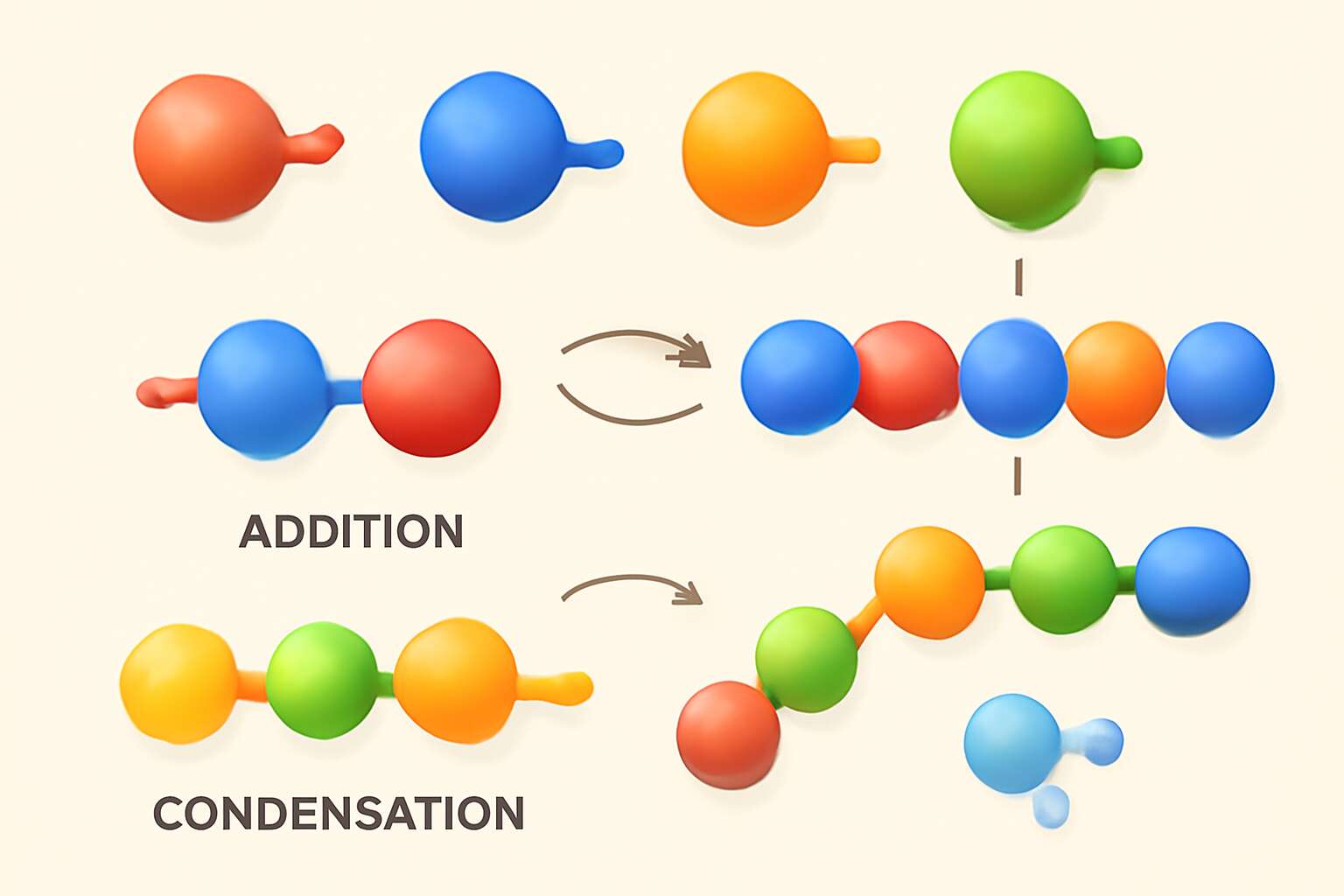
Understanding the two main pathways helps demystify the craft. In addition polymerization, monomers add to an active end without releasing small molecules, producing long chains quickly. In condensation polymerization, each addition pairs with a tiny by-product, like water, and bonds form as units join. In industry talk, polymers addition and condensation define two core routes.
Here are the practical distinctions:
- Addition: rapid chain growth, minimal by-products.
- Condensation: stepwise growth, small-molecule release.
- End product: tailored mechanical properties and processing behavior.
Key Concepts: Monomers and Polymers
Across laboratories and production floors in South Africa, polymer chains begin as humble monomers. They stretch into long architectures that shape phones, tires, and packaging. The engine behind this growth—polymers addition and condensation—reveals two graceful routes: one breathes through rapid chain-building, the other counts tiny by-products as it proceeds!
- Addition: monomers add to an active end without releasing small molecules, enabling rapid chain growth.
- Condensation: each step releases a small by-product, such as water, shaping chain architecture.
- End product: the chosen pathway tunes mechanical properties and how the polymer processes on the line.
For South African engineers and designers, this distinction informs material choices—from durable tires to recyclable packaging. Monomers and polymers dance in everyday life, and their choreography guides sustainability and performance.
Addition vs Condensation: Core Difference
In a South African lab, a single choice—fast chain-building or careful by-product accounting—shapes everyday life from tires to packaging. Two routes emerge: rapid addition and deliberate condensation, each with its own rhythm and promise.
To keep the line moving, consider these contrasts:
- Addition: monomers attach to an active end without releasing small molecules, enabling swift growth.
- Condensation: each step sheds a by-product, guiding structure and properties.
- End product: pathway choice tunes processing behavior and durability.
Understanding polymers addition and condensation informs material choices across industries. Monomers and polymers choreograph the everyday—phones, tires, packaging—without jargon, delivering performance with sustainability in the foreground.
Typical Monomer Types for Addition Polymers
Across South Africa’s labs and factories, a single choice can steer the fate of everyday things—from tires that bite the road to packaging that keeps secrets intact. Global plastic production dwarfs most industries, with roughly 400 million tonnes built each year. In that vast hum, two rhythms emerge: rapid addition and deliberate condensation.
Addition polymers grow in a breathless rush: monomers attach to an active end, no small molecule escapes, and the chain length climbs with each swift step. Condensation polymers move more deliberately, shedding a by-product at every turn—often water or a small alcohol—yet gaining control over density, temperature tolerance, and mechanical character.
Typical Monomer Types for Addition Polymers include:
- Ethylene
- Propylene
- Styrene
- Vinyl chloride
- Acrylonitrile
- Methyl methacrylate
- Vinyl acetate
These monomers unlock a spectrum of performance in phones, tires, and packaging, weaving sustainability into function. Understanding polymers addition and condensation informs material choices across industries. The dance of monomer and by-product shapes how a material behaves under stress.
Common Condensation Reactions and Byproducts
Across South Africa’s labs and factories, plastics output nears 400 million tonnes a year—a staggering chorus that makes every experiment feel like fate. In this landscape, polymers addition and condensation reveal two distinct paths to material form. Condensation routes sculpt polymers with precise density and heat tolerance, but they pay a price: byproduct molecules that stroll away as the chain grows. Understanding these routes sharpens choices for packaging, automotive parts, and beyond.
Common condensation reactions include esterification, yielding polyesters like those used in bottles and fibers, and amidation, building polyamides such as nylons. Each step releases a small molecule—often water or an alcohol—that must depart to make room for stronger bonds. The result is durable, temperature-tolerant polymers whose internal architecture governs stiffness, toughness, and chemical resistance.
Typical byproducts include:
- water
- methanol
- hydrogen chloride
Addition Polymerization Fundamentals
Mechanisms: Free-Radical and Ionic Pathways
Across industries, polymer production remains a roaring engine! Global output surpasses 360 million tonnes each year, feeding everything from packaging to pipelines. In the realm of polymers addition and condensation, addition-film growth unfolds by clever choreography of reactive centers and monomers.
Two principal routes frame the journey: a free-radical pathway, born from initiators that spawn reactive centers and guide chain growth, and ionic pathways, where charged species shepherd monomer additions. Free-radical polymerization shines in speed and versatility, while ionic mechanisms offer precision and control that can be “living” under the right conditions.
- Free-radical mechanism: initiation, propagation, termination—rapid, tolerant, and adaptable to many monomers.
- Ionic pathways: cationic, anionic, or coordination-based routes that yield tight molecular weight control and narrow distributions.
Together, these mechanisms illustrate how the art of polymers addition and condensation shapes the properties of plastics, elastomers, and fibers used across South Africa and beyond.
Initiators and Catalysts
Global plastics output tops 360 million tonnes each year, and the pulse behind that surge is the craft of initiators and catalysts in polymers addition and condensation. Initiation creates the first reactive center; propagation extends the chain as monomers join. Catalysts tune speed, weight distribution, and architecture, delivering everything from flexible films to strong fibers that win market share in South Africa and beyond.
- Initiators: organic peroxides, azo compounds, redox systems
- Catalysts: Lewis acids, organometallic catalysts, metallocenes
- Typical monomer families affected: styrenes, acrylates, dienes
- Process controls: temperature, light exposure, solvent choice
Free-radical routes blaze with speed and tolerance, while ionic strategies offer tighter control and sometimes living behavior under the right conditions. The choice hinges on monomer, desired architecture, and processing needs—core factors in modern polymer manufacture. In practice, this balance defines polymers addition and condensation in the modern toolkit.
Monomers and Propagation Steps
With global plastics output above 360 million tonnes a year, the secret lies in how polymer chains form. In polymers addition and condensation, vinyl monomers meet a reactive center to start chain growth. Propagation steps push the chain to length, as a growing radical adds successive monomer units. Monomer structure—substituents, sterics, and electron density—shapes reactivity and pace, while termination finally fixes the architecture.
Understanding propagation clarifies why some monomers rush to polymerize while others stall. Key features of propagation keep the momentum honest:
- Propagation step: the growing radical adds a monomer to form a longer chain radical
- Rate depends on monomer concentration and reactivity (k_p [M][P•])
- Chain length is set by termination or chain-transfer events
As the chain grows, termination and chain-transfer sculpt final properties, and that rhythm is the heartbeat of these polymerization dynamics in modern manufacturing.
Kinetics: Rate and Degree of Polymerization
Across the globe, more than 360 million tonnes of plastics roll off factory floors each year, and the secret is in how polymer chains stretch and click into place. In polymers addition and condensation, the growth rides on a living radical, sparking monomers into a long sequence. The rate of propagation hinges on two steady friends: monomer concentration and the reactive center. The longer the chain travels before it terminates, the heavier the final material. In South Africa’s workshops and fields of possibility, that same rhythm underpins everyday production.
Understanding propagation helps explain why some batches surge while others stall. In polymers addition and condensation, rate and degree of polymerization are shaped by:
- monomer availability drives the pace
- termination and chain-transfer limit chain length
- influences on reactivity from substituents and sterics
Industrial Examples of Addition Polymers
Around the plastics landscape, roughly 360 million tonnes of resin become products each year, a quiet testament to how chain growth governs strength. In factories and fields, polymer chains grow like a careful dance: monomers feed a living center, expanding the sequence with each encounter.
Addition polymerization rides a propagation rhythm: monomer concentration and the reactive center push the chain forward, while termination and chain-transfer set limits. Substituents and steric hindrance tune reactivity, guiding the pace without sacrificing practicality. The same rhythm powers industrial scale, from pilot plants to lines.
Industrial examples of addition polymers are everywhere: HDPE and LDPE for packaging; PVC for piping; polystyrene for cushioning; PMMA for clarity. All these belong under polymers addition and condensation in the broader lexicon of polymer science.
In South Africa, these materials underpin housing, agriculture, and infrastructure—pipes, containers, and coatings—where careful process control translates to performance and sustainability.
Condensation Polymerization Essentials
Step-Growth Concepts and Mechanisms
Across South Africa’s towns and farms, the quiet magic of polymers addition and condensation shapes everyday life. A bond formed in the glow of a furnace becomes packaging that keeps our harvests safe and our hopes intact.
In condensation polymerization, small, functional units meet in a step-wise dance, linking molecules while releasing a tiny partner. The growth is deliberate, turning simple inputs into a resilient network that endures rain and heat.
Two broad threads drive the mechanism: slow, steady chain buildup and the occasional branching that gives materials their shape. Conditions—temperature, a touch of catalyst, and the right monomer mix—steer the outcome without losing the human touch.
For readers across the country, these ideas translate into practical faith in what we build—polymers addition and condensation becoming sturdy, responsible choices that travel from factory to farm gate with care.
Byproducts and Water/Vapor Management
Across South Africa’s factories, condensation polymerization shapes everyday goods, from packaging to piping. A striking reality: in some plants, up to 40% of process water becomes condensate that must be captured and reused. Understanding byproducts helps operators cut waste, reduce emissions, and keep communities safe.
Primary byproducts in condensation polymerization are the small molecules released as bonds form. Water is the main partner, but depending on chemistry you may also encounter methanol, acetic acid, or hydrogen chloride. Effective management relies on closed systems, vent controls, and appropriate scrubbing.
- Condensate reuse where possible
- Distillation or dehydration for purity
Water and vapor management are not afterthoughts but core to reliability. Keep condensers efficient, monitor dew points, and route non-condensables away from processes. When viewed through the lens of polymers addition and condensation, every drop matters—saving energy, protecting workers, and extending material lifespans across farm gates and factories alike. Every drop matters!
Common Condensation Polymers: Polyester, Polyamide, Polyurethane
In the field of polymers addition and condensation, three common workhorses shape South Africa’s packaging, textiles, and automotive components: polyester, polyamide, and polyurethane. Each resin forms through step-growth chemistry, releasing small molecules as bonds close and chains grow, crafting materials with unique blends of clarity, toughness, and resilience.
- Textiles and fibers
- Packaging films
- Engineering components
Polyester arises from diols and dicarboxylic acids, yielding ester links that balance stiffness and clarity. It’s a workhorse in films and fibers, prized for dimensional stability and moisture resistance. In industrial South Africa, polyester films protect food packaging and support sustainable labels.
Polyamide, built from diamines and dicarboxylic acids, delivers tough, wear-resistant polymers used in engineering parts and textiles. Polyurethane, formed from isocyanates and polyols, creates foams and elastomeric skins with energy-absorbing traits. Together, these polymers illustrate the spectrum of condensation polymerization.
Molecular Weight Control and Functionality
In condensation-driven chemistry, achieving the right molecular weight is the quiet win that defines performance. For those navigating polymers addition and condensation, the trick isn’t merely making chains—it’s sculpting their length and end groups with precision. Equimolar balance, monomer functionality, and thoughtful catalyst choice merge to shape polymers with predictable strength, clarity, and resilience under South African industrial conditions.
Mastering molecular weight also means understanding functionality beyond mere size. The distribution of chain lengths, end-group fidelity, and the potential for branching all decide how a material behaves in textiles, packaging, and automotive components. By aligning monomer design with reaction dynamics, engineers can tailor properties without sacrificing processability.
- Stoichiometric balance aligns monomer ratios to control degree of polymerization and final chain length.
- Functionality and end-group design shape branching, network architecture, and mechanical performance.
- Kinetic control with gentle catalysts tunes molecular weight distribution and end-group fidelity.
Applications and Engineering Considerations
Polymers addition and condensation arenas are the quiet engines of modern materials. In South Africa’s manufacturing corridors, end-group fidelity can swing yields by as much as 12%—a statistic that hints at the art behind chemistry. The field rewards those who choreograph chain ends and monomer stoichiometry with the same zeal one reserves for a well-cut suit. This is the domain of polymers addition and condensation.
Applications span textiles, packaging, automotive components, and beyond, where polyester, polyamide, and polyurethane networks rely on controlled condensation steps. Engineering considerations include ensuring equimolar balance, tailoring functionality, and selecting catalysts that gently steer kinetics to favor predictable molecular weight and end-group fidelity. In practice, flow, heat transfer, and solvent byproducts must be managed to avoid defects in large panels, fibers, or molded parts.
When these elements align, the resulting materials perform under tough SA conditions with clarity and resilience.
Comparative Analysis and Applications
Material Properties: Strength, Thermal Stability, and Flexibility
Materials choice shapes uptime and performance in South Africa’s manufacturing corridors. A recent industry pulse puts polymer selection’s impact on lifecycle costs at around 20%, making early decisions critical. When comparing polymers addition and condensation, three metrics rise to the top: strength, thermal stability, and flexibility. The choice isn’t just stiffness; it’s how a material stands up to heat, load, and long use. In practice, addition polymers process easily and resist impact, while condensation polymers offer greater heat resistance and rigidity.
That trade-off plays out in real-world applications.
- Structural components with toughness
- Coatings and packaging with barrier properties
- Textiles and fibers demanding bendable comfort
Understanding these nuances under polymers addition and condensation helps engineers tailor solutions for local markets, from automotive trim to mining equipment housings.
Processing Techniques: Polymerization vs. Post-Polymerization
Under polymers addition and condensation, two processing philosophies shape durability and pace. Polymerization grows chains in situ; post-polymerization tweaks properties after formation. For South Africa’s factories, uptime and cost are as critical as the part, and the choice hinges on heat tolerance, load, and long use!
Two core pathways stand out:
- Polymerization: in-situ chain growth sets early form and impact resistance.
- Post-Polymerization: after-formation tweaks deliver heat resistance and rigidity without re-melting.
Application reality follows the flow: structural components, coatings, and textiles—each balancing strength and flexibility. In the South African context, recognizing polymers addition and condensation as the guiding framework helps tailor solutions for automotive trim and mining equipment housings.
Sustainability: Recycling and End-of-Life
Across South Africa’s manufacturing landscape, the journey from raw resin to end-of-life defines value and responsibility. Only about 9% of plastics have ever been recycled, a stark reminder that design must align with system realities. In this comparative space, polymers addition and condensation frame a clear path for evaluating durability, recyclability, and lifecycle costs. The choice between in-situ chain growth and post-formation tweaks reverberates through how products are used, repaired, and recovered, from automotive trim to mining equipment housings. In this crucible, reuse becomes a tale of resilience and resourcefulness.
- Recyclability within existing South African processing streams
- Energy balance: production versus end-of-life processing
- Material compatibility with post-consumer additives and sorting technologies
When these factors steer design, engineers seal options that endure heat and wear while ensuring graceful recovery at end-of-life, turning uptime into value and disposal into opportunity.
Market Trends: Bio-based and Sustainable Polymers
In South Africa’s manufacturing heartbeat, sustainability is a competitive edge rather than a buzzword. With plastics recycling hovering around 9%, the market leans into smarter material choices. Comparative analysis and applications market trends show that bio-based and sustainable polymers are not a gimmick but a recalibration of value. In this frame, polymers addition and condensation guide how performance and recoverability co-evolve, shaping products from packaging to automotive parts.
Bio-based polymers tap into volatile feedstock markets, policy incentives, and life-cycle accounting that favors lighter footprints. South Africa-specific considerations—energy, logistics, and local processing capabilities—shape adoption. The trend favors blends and compatibilized systems that ride existing lines, keeping capital lean while unlocking end-of-life recovery opportunities.
Key market drivers align with durable, recyclable, and cost-aware designs. The following factors influence selection in practice:
- Feedstock availability and price stability
- Processing compatibility with current lines
- End-of-life and recycling infrastructure
Choosing the Right Polymerization Route for a Product
Industry insight shows durability and lifecycle cost drive polymer adoption decisions, especially in South Africa where energy and processing constraints shape choices. In this frame, Comparative Analysis and Applications reveal that step-growth versus chain-growth hinges on end-use demands and recoverability. The phrase polymers addition and condensation anchors this discussion, linking performance to synthesis from resin chemistry to finished parts. A careful comparison weighs temperature profiles, processing windows, and compatibility with existing equipment, keeping capital lean while unlocking gains.
Applied choices unfold across packaging, automotive, and industrial components, where the right route balances speed, control, and recyclability. The crucial question becomes which polymerization route delivers the needed properties with sustainable end-of-life outcomes.
- End-use performance targets and service conditions
- Processing compatibility with current lines
- Recycling infrastructure and downstream recovery
That synthesis guides applications and helps engineers translate material choices into reliable, market-ready products.
Practical Considerations and Innovation
Safety and Environmental Impact in Polymer Synthesis
Practical considerations in polymer synthesis demand a steady hand and a clear conscience. In addition to cost and scalability, safety data sheets, local regulations, and energy use shape decisions. When addressing polymers addition and condensation, one note stands out: reaction exotherms must be tamed, impurities kept at bay, and solvent recovery streamlined to reduce waste. In South Africa, where energy sustainability is a national concern, choosing process routes with lower embodied energy matters as much as resin properties.
- Robust containment and monitoring systems to prevent exposure
- Efficient heat management to prevent runaway reactions
- waste minimization and recycling of solvents
Innovation and environmental impact go hand in hand. Green chemistry incentives, solvent-free or low-solvent routes, and end-of-life considerations guide new materials. Modern processes are designed to minimize byproducts like water or volatile organics, while maintaining performance. A practical checklist—insights that balance safety and innovation—might include:
Green Chemistry Approaches in Polymers
Across South Africa’s manufacturing floors, the energy footprint of plastics echoes like a distant drumbeat. Industry surveys hint at up to 30% energy savings when greener routes are chosen. In polymers addition and condensation, practical considerations demand robust containment, meticulous heat control, and disciplined solvent handling to tame exotherms and curb waste.
Three pillars keep safety and efficiency in balance:
- Robust containment and monitoring systems to prevent exposure
- Efficient heat management to prevent runaway reactions
- waste minimization and recycling of solvents
Innovation and environmental impact go hand in hand. Green chemistry incentives, solvent-free or low-solvent routes, and end-of-life considerations guide new materials. End-of-life compatibility is a quiet compass, steering resin design toward recyclability while preserving performance.
Characterization and Quality Control
Across South Africa’s factory floors, a quiet revolution hums beneath the hiss of reactors—smarter controls, tighter heat choreography, and smarter solvent stewardship keep exotherms in check and waste lean. In polymers addition and condensation, practical considerations become a compass: secure enclosures, precise temperature gradients, and disciplined solvent handling guide safe, scalable production. The result is a steadier rhythm, where safety and efficiency dance in step with ambition.
- Real-time process monitoring with closed-loop feedback
- Efficient heat exchange and staged temperature control
- Solvent recovery and waste minimization through recycling loops
For Innovation Characterization and Quality Control, the story continues. In polymers addition and condensation, inline analytics, rheology checks, and robust data practices ensure every batch speaks the same language. Digital twins, standardized tests, and provenance tracking shape performance, safety, and sustainability into a single, navigable map.
Emerging Catalysts and Monomer Design
Across South Africa’s manufacturing corridors, efficiency travels in quiet gradients—the temperature choreography and catalyst discipline that transform feed into dependable polymers addition and condensation. A well-tuned line trims waste, tightens tolerances, and leaves room for ambitious innovation without compromising safety.
Practical considerations lean on containment through design and scalable architecture that keeps pace with demand. Innovation flourishes in catalysts and monomer design that quietly redefine reactivity and selectivity.
- Biocatalysts and organocatalysts enabling cleaner initiation
- Bio-based monomers designed for reactivity and compatibility
- Continuous-flow architectures for steady heat and precise mixing
- Precision initiator systems improving molecular weight control
From these currents, a navigable map emerges—where performance, safety, and sustainability converge—polymers addition and condensation guiding scale with elegance in South Africa.
Case Studies: Industry Applications and Lessons Learned
Practical considerations in South Africa’s polymer energy lie in containment by design and scalable architectures that breathe with demand. A quiet choreography—tight boundaries, modular units, and safe heat management—reduces waste and preserves product integrity. Continuous-flow architectures keep heat steady and mixing precise, while precision initiator systems tighten molecular weight control without sacrificing throughput. In this arena, polymers addition and condensation become journeys toward dependable performance and safer operations!
Innovation case studies reveal how these currents translate into real-world value across sectors and corners of the country.
- Gauteng packaging converter cut energy use by adopting modular reactors for steady heat and inline mixing.
- KwaZulu-Natal materials supplier achieved tighter molecular weight distribution through process optimization and analytics, boosting consistency.
Together, these lessons guide SA leaders as they scale polymers addition and condensation with safety and sustainability at the core.



0 Comments