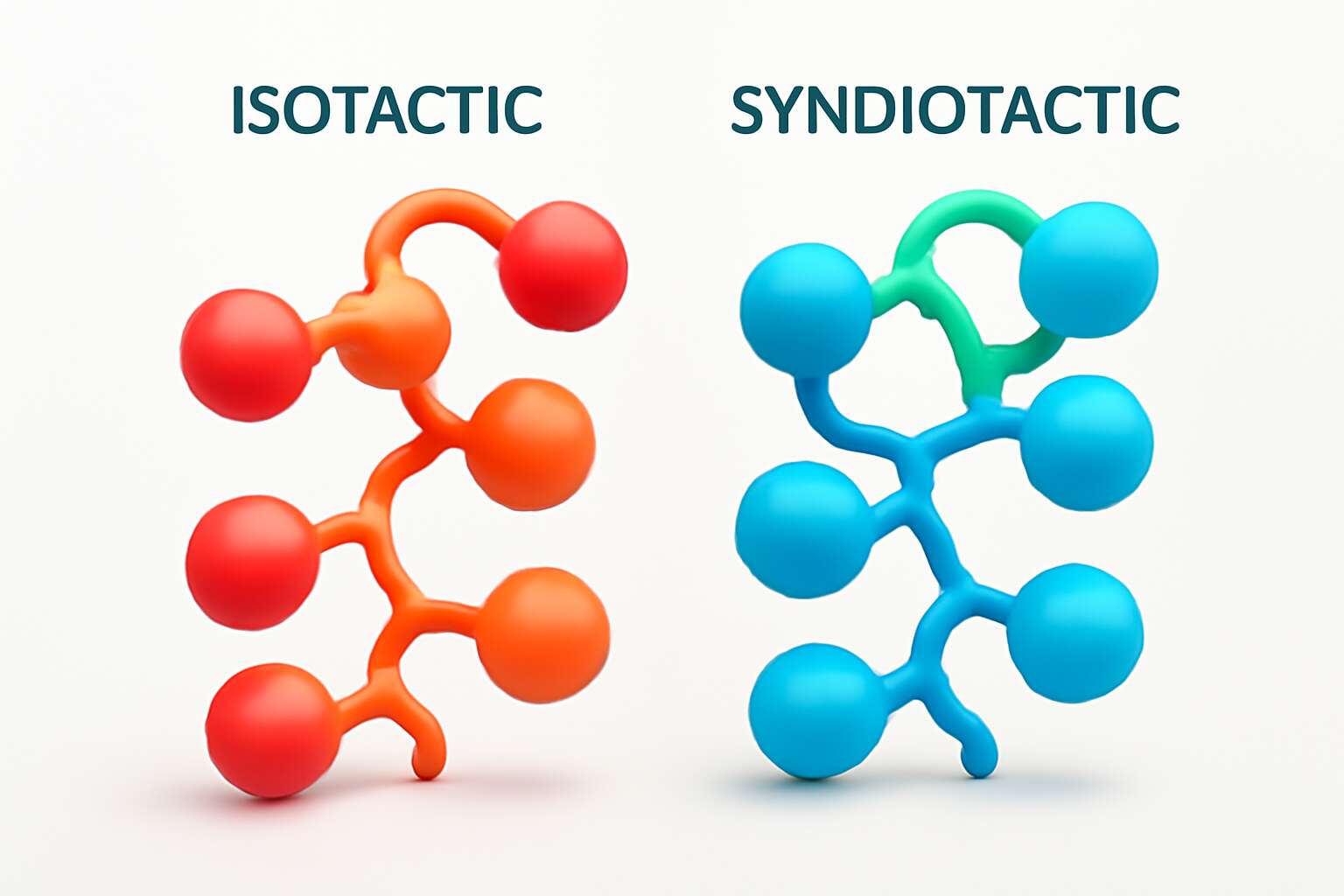
Overview of tacticity in polymers
Definition of tacticity and microstructure
An unseen order guides polymer performance. Tacticity refers to how side groups cling along the chain, forging microstructures that dictate everything from crystallinity to melt flow. Isotactic and syndiotactic arrangements tend to pack neatly, while atactic forms stay amorphous. Crystallinity in isotactic forms can reach 60–70%, a key lever for stiffness, clarity, and barrier properties. In practice, this idea is central to polymers based on tacticity.
Here’s how microstructure translates to real properties:
- Isotactic: all substituents on the same side, promoting orderly packing
- Syndiotactic: alternating sides, balancing order with flexibility
- Atactic: random placement, yielding amorphous, pliable material
Understanding tacticity unlocks tailored performance for coatings, packaging, and engineering plastics across South Africa’s markets! The microstructure controls diffusion, heat resistance, and processability, guiding product design toward sharper specifications.
Types of tacticity: isotactic, syndiotactic, atactic
In the orchestra of polymers, tacticity conducts the tune of performance. A minute shift in side-group alignment can boost crystallinity and heat resistance, with isotactic configurations reaching 60–70% in ideal blends. For polymers based on tacticity, the microstructure writes the rules—subtle order translates to tangible elegance across coatings, packaging, and engineering plastics.
There are three prevailing choreographies.
- Isotactic: uniform orientation promotes tight packing and high crystallinity
- Syndiotactic: alternating orientation balances order with flexibility
- Atactic: random placement yields amorphous, softer performance
In South Africa’s vibrant markets, the choice among these arrangements guides diffusion, heat aging, and processability. For coatings, packaging, and engineering plastics, polymers based on tacticity offer a spectrum—from glassy stiffness to resilient pliability—tailoring performance to climate, use, and logistics.
Impact on crystallinity and melting behavior
Crystallinity is a dial, not a destiny—crystal content in polymers based on tacticity can swing from the low single digits to the 60–70% range with the right orientation. That order shapes stiffness, heat aging, and dimensional stability, turning a raw material into a reliable workhorse.
Melting behavior follows this internal order: crystalline regions melt sharply at higher temperatures, while amorphous regions soften over a broader range. For polymers based on tacticity, processing windows shrink or widen with crystallinity, guiding how coatings cure, how packages resist heat, and how plastics endure South Africa’s varying climates.
Consider these levers that subtly reshape crystallinity and melting behavior:
- Cooling rate during solidification
- Molecular weight distribution and chain length dispersity
- Presence of comonomers or fillers that disrupt or promote order
In this dance, polymers based on tacticity write performance across coatings, packaging, and engineering plastics.
Historical milestones in tacticity research
Dark as a midnight corridor, tacticity reveals itself as the unseen conductor of polymer fate. In polymers based on tacticity, the twist of a chain can stiffen a material, sharpen heat resistance, or temper a cure with quieter precision. That whisper of stereo-regularity has steered labs and industries alike toward durable, predictable performance!
Across decades, milestones lit the path for inherent order:
- Early ideas linking chain symmetry to crystallinity and macromolecular order
- First stereospecific polymerizations that produced isotactic polypropylene
- Recognition and exploration of syndiotactic arrangements, expanding the toolkit
- The metallocene era, unlocking finer stereo-control and new families of materials
- Advances in characterization—NMR, DSC, and imaging—that reveal tacticity in action
Today, these milestones guide designers in South Africa, where climate and industry demand coatings that endure, packaging that resists heat, and plastics that stand the test of time.
Synthesis methods to control tacticity
Catalytic polymerization and stereoselectivity
In the world of polymers based on tacticity, synthesis methods to control tacticity act as the maestro, shaping how chains align and where order takes root. Catalytic polymerization, temperature, and monomer design converge to craft stereochemical destiny, turning a simple monomer into a chorus of arranged sequences rather than a random murmur.
Key strategies include catalytic polymerization and stereoselectivity that steer the chain’s fate.
- Chiral catalysts and ligands bias the direction of monomer addition
- Metallocene and single-site catalysts offer precise stereo control
- Controlled polymerization approaches balance rate and selectivity
From this precision arises predictable performance, where crystallinity and processability follow the cadence of stereoregularity. That is the power of polymers based on tacticity, translating subtle shifts into resilience across applications and end-uses, a cadence that speaks to South Africa’s plastics and packaging sectors.
Living polymerization strategies
Polymers that sing in tune with tacticity are reshaping South Africa’s packaging landscape; a seasoned chemist quips, “tacticity writes the performance script.” For polymers based on tacticity, synthesis methods act as conductors, coaxing monomers into orderly sequences rather than a random murmur. Living polymerization strategies, temperature, and initiator design converge to sculpt stereochemical destiny.
- Living anionic polymerization
- ATRP and related controlled polymerization
- RAFT and related mediators for stereochemical control
These approaches translate molecular precision into tangible performance, sharpening crystallinity control and processability across applications. The result is materials that glide through production lines with less energy, fewer defects, and a kinder footprint for South Africa’s plastics and packaging industries.
Copolymerization approaches for tacticity control
In SA packaging lines, controlling tacticity can trim energy use by up to 15% in extrusion—the kind of efficiency that keeps plant managers awake at night. A seasoned chemist leans in: “tacticity writes the performance script,” and the lab hums with possibility, a whisper of something bigger.
Synthesis methods to control tacticity hinge on copolymerization approaches for tacticity control, where stereospecific monomer pairing, tailored comonomer feeds, and selective catalysts bias sequence. By orchestrating blocky or alternating arrangements, researchers lock in crystallinity and processability, elevating performance in durable films and packaging materials—polymers based on tacticity.
Copolymerization approaches for tacticity control weave several levers into a cohesive strategy:
- Sequential monomer feeding to bias local stereochemistry
- Chiral catalysts and tailored regioselectivity
- Alternating and block designs that sculpt stereochemical zones
These dynamics push the performance envelope of plastics and packaging in South Africa.
Characterization and analysis of tacticity
NMR techniques for tacticity determination
In the loom of matter, a faint twist dictates destinies: a 5–10% shift in tacticity can swing crystallinity and mechanical temper like a dragon’s breath upon a shield.
To unveil this hidden order, NMR techniques become lanterns in the night. For polymers based on tacticity, 13C NMR is the crown jewel, with methine regions revealing isotactic, syndiotactic, and atactic fractions.
- 13C NMR spectroscopy of the methine region to quantify tacticity fractions
- 1H NMR data for chain-end environments and sequence distribution
- 2D NMR methods and spectral deconvolution to resolve overlapping signals
Interpreting these spectra demands careful calibration and a sense for subtle shifts, turning raw signals into meaningful descriptors of material performance within South Africa’s vibrant polymer landscape.
X-ray diffraction and crystallinity assessment
Diffraction patterns from X-ray scattering illuminate crystallinity in polymers, especially for polymers based on tacticity. By analyzing diffracted intensity, we gauge how ordered the chains are, a quiet predictor of strength, stiffness, and heat resistance in South Africa’s dynamic polymer landscape.
- Sample quality and orientation influence peak shapes and reliability.
- Peak deconvolution exposes crystalline versus amorphous fractions.
- Calibration against standards links diffracted intensity to crystallinity metrics.
Careful interpretation handles peak broadening and preferred orientation, turning XRD into a reliable compass for predicting how microstructure shapes performance in real-world applications.
Infrared and Raman spectroscopy for stereoregularity
In the quiet hum of the spectrometer, a polymer’s silent order tells a loud story. For polymers based on tacticity, infrared and Raman spectroscopy become a compass, guiding us to stereoregularity without breaking the chain.
IR tracks how dipole-active groups respond to subtle order, while Raman highlights backbone symmetry in vibrational fingerprints. Together they unveil stereoregularity with speed and non-destructiveness, supporting agile material design.
- IR detects dipole changes tied to chain arrangement, offering quick stereoregularity readouts
- Raman captures symmetric backbone vibrations that reflect local ordering
- Combined interpretation improves confidence for polymer development in the South Africa market
Thermal analysis correlations with tacticity
“Order in the chain is the quiet engine of performance,” and that insight lands squarely in South Africa’s plastics arena. Polymers based on tacticity reveal themselves through subtle heat and stiffness cues, guiding designers toward materials that endure in real-world service.
Thermal analysis ties tacticity to performance by tracking how glass transition, heat flow, and relaxation signatures shift with chain arrangement. DSC and DMTA reveal trends in stiffness and energy dissipation, helping engineers predict service stability without sacrificing processability.
Key signals to watch in thermal analysis for tacticity:
- DSC: glass transition and heat-flow shifts
- DMTA: relaxation and stiffness changes
- Thermomechanical profiling: local order fingerprints
These insights empower the South Africa market to tailor formulations that balance performance with sustainability, turning chain order into a strategic asset.
Chromatographic methods and stereoregularity
Order in the chain speaks louder than heat—a hook that lands in South Africa’s plastics labs. Characterization and analysis of tacticity by chromatography reveal the hidden choreography of monomer sequencing, translating subtle order into predictable performance for polymers based on tacticity.
Chromatographic methods coupled with stereoregularity offer a granular view. Chiral HPLC separates stereochemical fragments after derivatization; chiral GC provides complementary confirmation; LC-MS sequencing maps triad distributions.
- Chiral HPLC for enantioselective separation
- Chiral GC after derivatization
- LC-MS sequencing for triad patterns
Interpreting these fingerprints demands cross-checks with other signals, but the payoff is clear: for polymers based on tacticity, these fingerprints become the key to scalable, sustainable, high-performance formulations in the South African market.
Applications and performance implications
Mechanical properties and processability
In SA’s high-stakes plastics sector, a small tweak in tacticity can yield outsized performance—think a 15% jump in targeted strength and clarity in premium packaging and automotive components. Polymers based on tacticity unlock a design language where crystal orientation and chain packing determine the spectrum of properties under stress. This isn’t coincidence; it’s a disciplined way to dial stiffness, toughness, and barrier performance to fit a specific need.
Applications and performance implications weave into everyday goods. Consider these areas where controlled tacticity makes a difference:
- High-barrier, clear films for food packaging
- Lightweight, rigid components for automotive interiors
- Strong, fatigue-resistant fibres for outdoor applications
On the factory floor, the payoff is pragmatic: tuned tacticity shifts melt strength, drawability, and molding windows, allowing smoother processing without compromising performance in the finished part. That balance gives SA producers a competitive edge in films, fibres, and molded components.
Barrier properties and thermal stability in tacticity-engineered polymers
Barriers that keep flavors in and oxygen out do more than protect; they define shelf life and brand trust. In tacticity-tuned materials, barrier performance tracks the choreography of crystal packing, while thermal stability keeps films calm under heat and light. Polymers based on tacticity unlock a rare blend of clarity, stiffness, and resilience—attributes that let premium packaging endure demanding environments without sacrificing appearance.
These properties translate on the factory floor into steadier melt strength, tighter gauges, and broader processing windows. Consider the practical implications:
- Moisture and gas barrier improvements in clear films
- Thermal resilience for high-temperature processing
- Dimensional stability in outdoor fibers and components
In South Africa’s climate and supply chains, that balance translates to lower waste and better performance.
Industry examples and case studies
In the realm of polymers based on tacticity, shelf-life becomes a poem you can measure. Barriers rise like a quiet chorus, keeping flavors in and oxygen out, while crystal choreography lends clarity, stiffness, and resilience that endure under heat and light!
Applications and performance implications unfold across industries.
- Moisture and gas barrier improvements in clear films
- Thermal resilience for high-temperature processing
- Dimensional stability in outdoor fibers and components
In South Africa’s climate and supply chains, these capabilities translate into steadier production windows, lower waste, and better performance on supermarket shelves. Industry examples and case studies highlight SA beverage packaging, agricultural films, and outdoor textiles benefiting from tacticity-tuned materials.
From Durban to Bloemfontein, the story is about reliability meeting beauty, where premium packaging keeps its appearance even as conditions test it.



0 Comments